
Why Does Motif Symmetry Matter in Van Cleef Pieces?
Check out our Van Cleef & Arpels collection!
When you really look at a Van Cleef & Arpels piece under decent lighting, the geometry almost feels obsessive. Motif symmetry in Van Cleef jewelry isn’t just for looks. It’s a dead giveaway for authenticity, resale value, and that iconic appeal. Even the tiniest imbalance can tip you off to whether you’re holding a genuine maison creation or a fake.
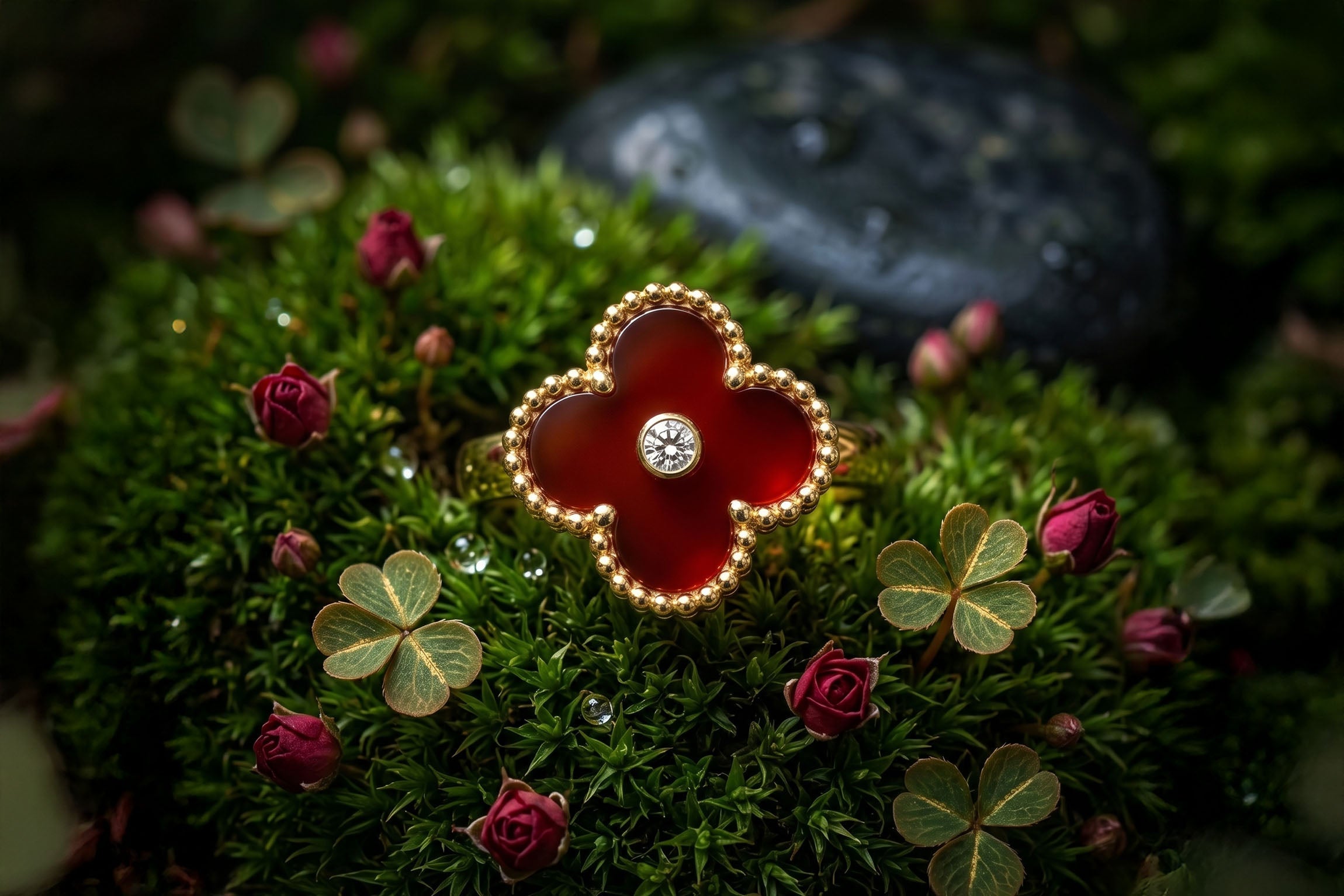
The brand’s reputation basically lives and dies on this mathematical precision, especially with the Alhambra collection. Every clover lobe is supposed to match its siblings in size, curve, and spacing.
After handling and authenticating hundreds of VCA pieces, I can say symmetry is where knockoffs almost always trip up. Genuine Van Cleef motifs show flawless alignment where the lobes meet, perfect beading around every edge, and stones that sit smack in the middle of their bezels. Fakes? They tend to have weird proportions, wobbly borders, or off-center stones. Once you know what to look for, it jumps out.
Learning about motif symmetry protects your investment, whether you’re buying, selling, or consigning Van Cleef & Arpels. The line between authentic and a really good replica is sometimes just a millimeter or two, but spotting those details gives you a leg up in the luxury resale world.
Key Takeaways
-
Motif symmetry is the biggest tell for authentic Van Cleef pieces. Look for precise alignment and balanced shapes
-
Perfect symmetry in beading, stone placement, and lobe geometry keeps resale value high and shows true craftsmanship
-
Spotting symmetry flaws helps buyers and collectors steer clear of fakes
The Core Role of Motif Symmetry in Van Cleef & Arpels Pieces
Motif symmetry in Van Cleef & Arpels isn’t just for show. It’s both a design rule and a way to spot the real deal. When the symmetry’s right, the piece looks stunning, signals quality, and holds its value on the resale market.
How Symmetry Elevates Aesthetics and Recognition
The Alhambra motif is all about that four-lobe symmetry. Each lobe needs to mirror the others in size, curve, and spacing, just as Jacques Arpels wanted back in 1968.
Get the symmetry right, and the motif looks harmonious from every angle. You can spin it around and it still looks the same. That kind of geometric discipline is what separates authentic Van Cleef & Arpels from imitators that just sort of mimic the shape.
Symmetry shows up in how light plays off the motif. When lobes line up perfectly, you get consistent shadows and reflections. Even a little asymmetry throws things off, making the piece look lopsided or awkward.
The Alhambra’s symmetry also means you can mix and match necklaces, bracelets, and earrings. They all work together because the motifs are identical.
Authenticity Indicators in Symmetrical Motifs
Counterfeit Van Cleef Alhambra pieces usually mess up the symmetry before anything else. You’ll see lobes that aren’t quite the same width, curves that flatten out, or proportions that just feel off.
Common symmetry fails in fakes:
-
Lobe sizes don’t match between sections
-
Curve radius changes at the edges
-
Beading drifts off-center or looks uneven
-
Motif height and width are out of whack
-
Spacing between lobes isn’t consistent
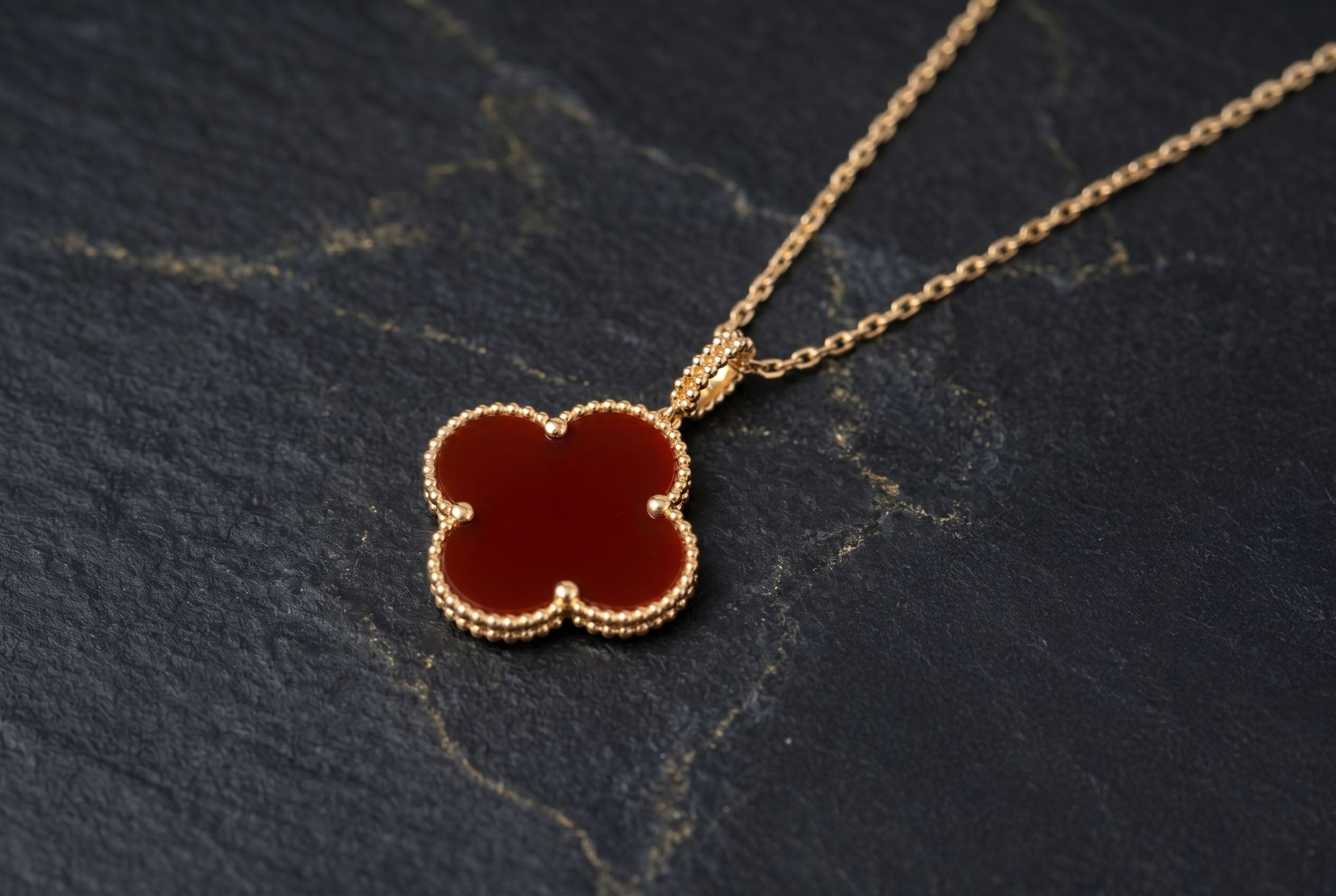
Authentic Van Cleef sticks to strict size rules across all Alhambra motifs. A Vintage Alhambra pendant in onyx should match the mother-of-pearl version, no matter the material. That makes symmetry checks pretty reliable across the board.
When authenticators check a piece, geometry comes first. It’s a lot harder to fake perfect symmetry than it is to fake gold or even hallmarks. Even high-end counterfeits with real gold rarely nail the lobe proportions and bead placement like the factory does.
Impact on Investment Value and Collectability
Symmetry has a big impact on resale prices. If a piece has even a slight motif misalignment, it’ll fetch less, even if it’s otherwise authentic.
Collectors and seasoned buyers always check symmetry before buying. Perfect symmetry tells you the maker paid attention to every detail, from the clasp to the chain.
We get more authentication requests when people spot symmetry issues in listing photos. Folks know that geometric problems raise authenticity questions, which can haunt future resale. Top-tier Van Cleef pieces have to pass the symmetry test to keep their value.
Vintage Alhambra pieces from earlier years often hold their value because their symmetry has stood the test of time. If a motif still looks balanced after decades, it says a lot about Van Cleef & Arpels’ construction compared to pieces that warp or lose their shape.
Anatomy of the Alhambra Motif: Where Symmetry Shines
The Alhambra’s precision comes down to three things: the four-leaf clover’s symbolism, the Moorish quatrefoil’s geometry, and those signature beaded edges that frame every motif with a kind of mathematical neatness.
Origins and Symbolism of the Four-Leaf Clover Motif
The four-leaf clover actually showed up in Van Cleef & Arpels’ archives way before the Alhambra collection launched in 1968. Jacques Arpels, the founding couple’s nephew, used to pick real four-leaf clovers in his garden and hand them out for good luck. His motto, “To be lucky, you must believe in luck,” kind of sums up the spirit behind the design.
When the first Alhambra long necklace dropped, it had 20 clover-shaped motifs in textured yellow gold. The design took the clover’s four lobes and turned them into a repeatable, geometric pattern. This blend of nature and precision set the standard for all the Alhambra variations we see today.
The clover motif works on two levels: it’s got emotional pull (luck!) and it’s visually distinct. Collectors want pieces where each lobe mirrors the others exactly.
The Importance of the Moorish Quatrefoil Influence
The collection’s name nods to the Alhambra Palace in Spain, where quatrefoils are everywhere. A quatrefoil is basically four overlapping circles or arcs, making a symmetrical four-lobed shape. You see it all over Islamic art and Gothic design.
Van Cleef & Arpels took the organic clover and merged it with the quatrefoil’s strict geometry. So from a distance, it feels natural, but up close, you see the engineering. Each lobe meets its neighbor at just the right angle, forming four equal sections with even spacing.
That quatrefoil influence is why authenticators focus so much on symmetry. Real pieces keep the lobes perfectly proportional, a standard that’s tough to fake without Van Cleef’s templates and quality checks.
Signature Beaded Edges and Their Role in Symmetry
The beaded edge wraps every Alhambra motif in uniform gold spheres, giving the clover shape extra definition. These aren’t just pretty details. They’re structural, and they finish off the motif’s symmetry. Every bead needs to match its neighbors in size, spacing, and alignment to pass the authenticity test.
Beading does a few things. It reinforces the motif’s edges, protects the center, whether it’s mother-of-pearl, onyx, or malachite, and gives the piece a tactile feel that’s hard to miss. The beads catch light differently, throwing subtle shadows that highlight the quatrefoil shape.
We always check beading closely when authenticating. If bead sizes or spacing are off, it’s a red flag for shortcut manufacturing, not Van Cleef’s way. Authentic pieces show perfectly uniform beading all the way around, with each bead carefully soldered and polished. This attention to detail runs through the whole Alhambra line, from the petite Sweet Alhambra pendants to the big Vintage Alhambra statements.
Craftsmanship and the Pursuit of Perfect Proportion
Van Cleef & Arpels keeps a tight grip on quality, and that shows up directly in motif symmetry. The careful balance of materials and obsessive production methods are why real pieces hold their value.
Strict Quality Control and Artisan Techniques
Van Cleef & Arpels uses multi-stage inspections at every step. Artisans check beaded gold borders repeatedly, measuring bead size and spacing with precision tools. Each motif has to pass several checkpoints before it moves on.
The beading process is all handwork. Artisans place each bead along the motif, keeping the height and spacing consistent. That’s how they get the signature raised border. Fakes usually skip this step, opting for stamped or cast borders that look flat and uneven.
Jump rings are soldered with invisible seams, placed so the motif hangs straight. Counterfeiters tend to slap these rings on wherever, or they leave messy solder spots.
In the workshop, artisans use magnification to make sure motif edges line up. If something’s off, the piece gets rejected or redone.
The Balance of Materials: Stones, Metals & Motif Thickness
Every Van Cleef Alhambra piece uses 18k gold, marked Au750 (that’s 75% pure gold). Motif thickness stays pretty consistent, usually 1.8 mm to 2.2 mm, depending on the collection. Fakes often use thinner metal to save money, and you’ll feel the difference.
Mother-of-pearl, onyx, malachite, carnelian, and turquoise are all cut to exact specs. Stone thickness matches across all motifs in a piece, usually around 1.5 mm. Van Cleef picks gemstones for color uniformity, though some natural variation, like in malachite, is normal.
The ratio of metal to stone matters for how light hits the motif. Beaded borders should have the right height compared to the stone inlay, creating a shallow channel that holds the stone but shows off its surface. The border width should stay the same all the way around. If it doesn’t, that’s a sign of sloppy work or a fake.
How Symmetry Signals Authenticity Versus Replicas
Authentic Van Cleef & Arpels Alhambra pieces show off a level of symmetry that counterfeiters just can’t match. Geometric analysis is often the best way to spot a fake before you even get to the materials or serial numbers.
Key Symmetry Details to Inspect During Authentication
Start with the beaded edge. You want even bead size and perfect spacing all the way around. Each bead on a real Alhambra piece sits the same distance from its neighbors, and the beading follows the motif curve with no gaps or bunching.
Lobe symmetry means all four lobes are identical in size and shape. Try rotating the piece in your mind 90 degrees and compare the lobes. On a real Van Cleef, each quarter looks the same.
Motif thickness should be uniform all around. Measure from the beaded edge to the inner edge at different points. Variations usually mean sloppy finishing, which you see a lot in fakes.
Clasp alignment matters, too. On a real Alhambra pendant or bracelet, the clasp is centered with the motif. Jump rings connecting chain to motif should line up without twisting or being off-center.
Common Red Flags and What Counterfeits Get Wrong
Irregular bead count is a big giveaway. Real Van Cleef & Arpels Alhambra pieces use specific bead counts for each motif size, but fakes often fudge this to cut corners.
Lobe shapes in fakes are often off. One might be squished or stretched compared to the others. That’s usually a tooling issue, and Van Cleef’s standards don’t allow it.
You’ll see motif thickness vary in replicas, especially when they use cheap stamping or hand-cutting. It’s not uncommon to find pieces where the top and bottom lobes aren’t the same thickness.
Clasps on fakes often sit crooked. Always check if the clasp barrel lines up with the motif’s axis. Authentic pieces keep everything in strict geometric order.
Evolution of Motif Symmetry Across Van Cleef & Arpels Collections
Since 1968, Van Cleef & Arpels has played with motif symmetry in each new collection. Every line brings its own twist on symmetry, which affects both looks and resale value. The Alhambra variations show how the house balances perfect symmetry with a bit of intentional asymmetry, while collections like Perlée and the Zip necklace use symmetry in totally different ways.
Comparing Vintage, Pure, Sweet, and Magic Alhambra
The Vintage Alhambra collection sticks to strict symmetry. Every four-leaf clover motif lines up with identical proportions and golden beading that keeps the spacing even all the way around. Each motif matches in size, something you can't overlook if you're checking authenticity.
Pure Alhambra takes a minimalist route, skipping the beaded edge altogether. The smooth, polished gold creates a pillowy look, and without the beading, any asymmetry jumps out right away. It's a bold move. There's nowhere for imperfections to hide.
Sweet Alhambra shrinks the motif down to miniature size but keeps that perfect four-way symmetry. The smaller the piece, the trickier it gets for makers to keep everything lined up. Honestly, this is where authentication gets tough. Counterfeiters often mess up the symmetry at these tiny scales.
Magic Alhambra? That's a whole different story. This line tosses out the symmetry rulebook and mixes motifs of various sizes in one piece. You'll see small, medium, and even extra-large motifs together, creating a kind of visual tension that stands out from the uniformity of the Vintage collection. Here, the asymmetry is intentional and well-documented, not a flaw.
Perlée, Zip Necklace, and Other Iconic Variations
The Perlée collection shows off Van Cleef's knack for symmetry, but with a different approach. No clovers here, just rows of golden beads, each one matching the next, arranged in perfectly spaced, symmetrical patterns.
Then there's Van Cleef's Zip necklace, a high jewelry piece that uses radial symmetry. The zipper has to line up on both sides for the mechanism to work and for the necklace to look balanced when worn. If the teeth don't align, you notice it immediately.
High jewelry pieces from Van Cleef often push symmetry even further. Multiple stones have to sit in exact geometric patterns. If they're off even a little, the way light reflects gets thrown off, and the whole piece feels unbalanced.
Cultural Impact and Symbolism in the Luxury Market
Van Cleef & Arpels took the four-leaf clover, a simple symbol of luck, and turned it into a global status icon through careful symmetry and consistent design. The Alhambra collection carries cultural weight, thanks to celebrity exposure and that deep-seated desire to own something perfectly balanced and, maybe, a little bit magical.
Pop Culture, Celebrity Endorsement, and Social Media
The Alhambra necklace shows up everywhere, on celebrities, influencers, you name it. That visibility pushed it from a niche luxury item to a must-have status symbol. When stars wear Van Cleef, those symmetrical clovers end up in paparazzi shots and Instagram feeds, keeping the brand in the spotlight.
We've seen the VCA Alhambra bracelet and pendant become a kind of shorthand for good taste online. The motif's symmetry pops in photos. Even in grainy images or quick clips, you can spot it. That instant recognition drives demand. Buyers want pieces that signal luxury without needing to spell it out.
The balanced proportions and beaded edges make Alhambra motifs stand out in pictures, which matters when jewelry gets as much attention on screens as in real life. Whether you're a collector or just buying your first piece, there's something about that mix of personal meaning and social cachet. Van Cleef & Arpels jewelry keeps its cultural punch because the symmetry is so visually consistent. It translates everywhere.
Lucky Charm: Why Collectors Chase Symmetrical Alhambra
The four-leaf clover motif taps into universal ideas about luck and protection, but let's be honest. Collectors care just as much about the craftsmanship. When each Alhambra clover shows off perfect symmetry, it feels rare and valuable, not like something churned out in a factory.
Buyers flock to the Alhambra collection because the symmetry feels intentional, almost meditative. Every balanced lobe and evenly spaced bead suggests order and good fortune, adding emotional weight beyond just the materials.
Van Cleef Alhambra pendants and multi-motif necklaces act like modern talismans. People pick materials for their symbolism: mother-of-pearl for calm, onyx for strength, malachite for transformation. The symmetry keeps the message clear, so each piece feels deliberate, not just decorative.
Frequently Asked Questions
Motif symmetry changes everything, from how a piece catches the light to whether collectors see it as investment-worthy. Here’s what people ask most about Van Cleef & Arpels’ obsession with geometric balance.
How does motif symmetry enhance the aesthetic appeal of Van Cleef pieces?
Perfect symmetry changes how light bounces off each Alhambra motif. When all four lobes match in size and curve, the piece reflects light evenly and gives that clean, balanced Van Cleef look. Our eyes naturally respond to symmetry, so the motif feels polished, calm, and instantly recognizable.
In what ways does precise symmetry influence the valuation of Van Cleef & Arpels jewelry?
Collectors use symmetry as a quality check. Motifs that line up perfectly, with uniform beading and balanced proportions, usually command stronger resale prices. If a piece looks uneven, buyers may question condition, repairs, or authenticity, which can push the value down.
Could you explain how motif symmetry affects the authentication process for Van Cleef & Arpels items?
Symmetry is one of the fastest ways to screen a piece. Authenticators compare lobe shape, spacing, bead size, and stone placement. On genuine pieces, these details stay consistent all the way around. Fakes often miss that precision, even when other details look convincing at first glance.
Why is symmetry considered a critical aspect in the craftsmanship of Van Cleef & Arpels jewelry?
Van Cleef & Arpels is known for precision. The Alhambra motif only works when its proportions stay consistent, whether the piece is large or small, plain gold or set with stone. Symmetry shows that the maker paid attention to geometry, finishing, and how the piece will wear.
Can uneven motif symmetry impact the resale value of Van Cleef & Arpels pieces?
Yes. Visible asymmetry can hurt resale value because it raises questions. Collectors are often more forgiving of even wear than of crooked motifs, uneven beading, or off-center stones. Those flaws can make a genuine piece harder to sell and a questionable piece much easier to reject.
What role does motif symmetry play in the overall wearability and styling of Van Cleef & Arpels collections?
Symmetrical motifs tend to sit flatter, hang straighter, and layer better. When the balance is right, necklaces and bracelets drape more naturally and look cleaner in person and in photos. If symmetry is off, pieces can twist, bunch, or sit awkwardly.
Love Hermès? See More from Rome Station
Add us to your Preferred Sources on Google to see our newest Hermès guides and insider tips first.