
How to Spot Misaligned Motifs in Van Cleef & Arpels Designs
Check out our Van Cleef & Arpels collection!
Van Cleef & Arpels pieces are famous for their symmetry and sharp execution, so misaligned motifs are often the first clue that something’s off. If you’re eyeing a genuine Van Cleef & Arpels piece, be it those iconic Alhambra clovers or their delicate Frivole petals, the motifs should appear centered, balanced, and consistently aligned, with no visible gaps or asymmetry to the naked eye. Once you get familiar with the real thing, their attention to detail really pops.
Counterfeiters have a tough time nailing the exact proportions and alignment that Van Cleef & Arpels achieves through their strict quality control. The differences can be subtle, but if you know what to look for, misaligned motifs jump right out. Here’s a guide to help you spot those red flags and avoid getting burned by fakes.
Spotting these imperfections isn’t just about staring at the motifs. There’s a whole relationship between alignment, prong placement, material quality, and engraving accuracy that comes into play.
Key Takeaways
- Authentic Van Cleef & Arpels motifs are always symmetrical, precisely spaced, and perfectly centered.
- Misalignment usually comes with other issues, think uneven prongs, sloppy finishing, or off-kilter hallmarks.
- Real authentication means inspecting motifs, clasps, engravings, and the overall craftsmanship.
Understanding the Hallmarks of Authentic Van Cleef & Arpels Motifs
True Van Cleef & Arpels pieces have certain marks that set them apart: sharp stampings, clear metal quality indicators, and serial numbers that aren’t just slapped on. The Alhambra collection, for example, keeps its design elements consistent and to a very high standard.
Key Features of Genuine Alhambra Motifs
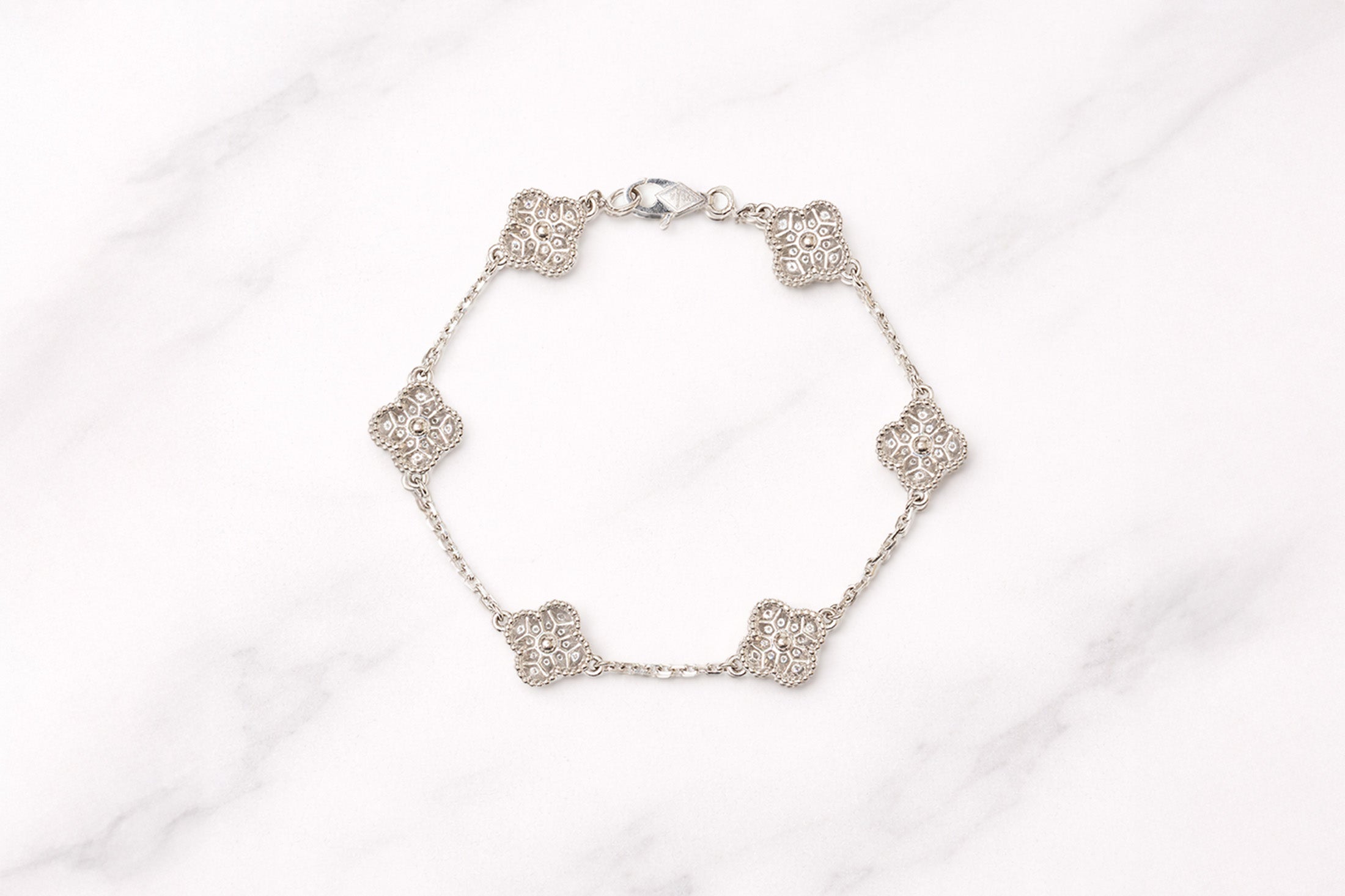
Alhambra clovers in authentic pieces keep their proportions spot-on. Each of the four lobes is symmetrical and even. If you check out the beaded edge, it’ll be uniform, no random big or tiny beads.
Every Alhambra motif in the same size category should measure consistently, with only negligible manufacturing tolerances. The clover sits snug within its gold bezel, with no gaps or unevenness between the stone and the border.
That signature beading? On real Van Cleef jewelry, those tiny gold beads are all the same size and spaced just right. Up close, it looks like a smooth, rope-like texture, never sloppy or inconsistent.
Authentic Alhambra Characteristics:
- Symmetrical four-leaf clover shape
- Even beaded border
- Stone fits flush in the bezel
- Smooth, consistent metal finish
- No visible gaps
Signature Stamping and Engraving Standards
Van Cleef & Arpels stamps their pieces with crisp, legible purity marks. You’ll see “AU750” for 18k gold and “PT950” for platinum. These marks show up in the same spots, depending on the piece.
The brand stamp, either “VCA” or “Van Cleef & Arpels”, sticks to a specific font. Look for clean, evenly spaced letters with a nice depth. Run your fingernail over it, and you’ll feel a slight recess.
Fake pieces often have wobbly stamps: weird fonts, uneven spacing, or shallow impressions. The real deal keeps it sharp and professional.
Serial Numbers and Metal Quality Marks
From the late 1970s onward, most Van Cleef & Arpels pieces feature unique serial numbers, though placement and format vary by era and collection. On Alhambra bracelets, it’s usually on the back of a motif or on the clasp.
Serial formats vary by production period and collection and may include letters, numbers, or a combination of both. Real engravings are clean and even, done either by laser or by hand, but always with care.
Metal purity marks, most commonly AU750 for gold, appear next to the serial number. You should see both the metal mark and the VCA stamp, placed so they’re visible but don’t mess with the look of the piece.
Visual Comparison: Real vs. Misaligned Motifs
Authentic Van Cleef & Arpels pieces show tight geometric consistency. Counterfeits, though, usually give themselves away with alignment issues, if you know what to check.
Shape and Proportion Details
A real Alhambra clover sticks to exact proportions. Each lobe is the same width and height, so if you drew lines through the center, you’d see perfect symmetry.
Genuine motifs keep a specific petal-to-bezel ratio that fakes rarely get right. The real ones have rounded lobes with a slight point where they meet, not overly round or weirdly angular. Counterfeits often have lobes that look squashed or stretched, and sometimes one is bigger than the others.
The gold beading around each motif sits at a fixed distance from the stone. On authentic pieces, this border never varies.
Key proportion indicators:
- All lobes are the same size
- Even spacing between lobe points
- Same curve on every petal
- Consistent metal border thickness
Alignment Consistency Along Bracelets and Necklaces
Lay an Alhambra bracelet or necklace flat, and real motifs line up perfectly. The center of each clover forms an invisible straight line.
Fake necklaces often have motifs that twist or sit at odd angles. Check how each motif connects to the chain. On genuine pieces, these links always attach at the same spot on each clover.
Spacing between motifs? It’s exact on real pieces. Count the links between motifs, and it’ll always match. Fakes usually mess this up, with some motifs closer together than others.
Differences in Beading and Symmetry
That signature gold beading on real Van Cleef & Arpels jewelry is crazy uniform. Each bead is the same size and spaced just right.
If you trace the beading around an Alhambra motif, you’ll see a mirror image on both sides, vertical or horizontal. Beads line up so well that matching beads on opposite sides are the same distance from the center.
Fakes? Their beading often looks slapped on, with gaps, overlaps, or beads that aren’t all the same size. Sometimes the beads are too big or too small for the motif, throwing off the whole look.
| Feature | Authentic VCA | Counterfeit |
|---|---|---|
| Bead size | Uniform throughout | Varies noticeably |
| Bead spacing | Mathematically precise | Irregular gaps |
| Symmetry | Perfect mirror image | Asymmetrical placement |
Material Quality and Motif Authenticity
Van Cleef & Arpels uses top-tier materials that fakes just can’t match. Knowing the hallmarks, gemstone traits, and physical feel of real pieces makes it a lot easier to spot the difference.
Gold and Platinum Hallmarks: What to Look For
Real Van Cleef & Arpels pieces in 18k gold always have the AU750 hallmark, showing 75% gold content. This stamp should be deep and clean, not scratchy or faint.
For platinum, you want the PT950 mark, 95% platinum. These marks usually show up near the brand signature, inside bracelets, on the back of pendants, or inside rings.
Placement and quality matter. Real stamps are perfectly positioned and even. Fakes often have uneven stamps, with letters that look lighter or misaligned.
A 10x loupe really helps here. Real pieces have sharp stamp edges, while fakes show rough borders or uneven depth.
Spotting Fake Gemstones in Motifs
Van Cleef & Arpels sources stunning stones for their Alhambra motifs: mother-of-pearl, malachite, onyx, turquoise, and blue agate. Each has unique qualities that fakes miss.
Mother-of-pearl should have a natural shimmer with color shifts, never flat or plastic-y. Fakes often use resin or plastic that looks dull and lifeless.
Malachite shows natural green bands, never perfectly symmetrical. Each stone is unique. Fakes often have repeating patterns or printed designs.
Onyx in real pieces is deep black but slightly translucent if you hold it to the light. It feels cool and has weight. Fakes are usually opaque and feel warmer.
Turquoise and blue agate have natural matrix patterns and color shifts. Real stones show slight tone and texture variations, fakes just can’t pull that off.
Texture, Weight, and Finish Checks
The feel of the metal is a giveaway. Real 18k gold feels hefty and balanced. Fakes with gold-plated base metals are lighter and often feel cheap.
Genuine pieces have a super smooth, even polish. No rough spots, bubbles, or weird textures. Run your finger along the metal, any bumps or sharpness usually mean it’s a fake.
Chain links, clasps, and jump rings should move smoothly. The finish stays consistent, while fakes often show patchy polish or thin plating.
Edges on authentic pieces are seamless and comfy. Prongs grip stones tightly, with no gaps, and all edges are rounded. Fakes often have sharp edges or visible seams where metal parts join.
Prongs, Settings, and Craftsmanship Flaws
Van Cleef & Arpels prongs are a thing of beauty, rounded, uniform, and perfectly placed. Counterfeits usually have uneven spacing, odd shapes, and rough finishes.
Prong and Setting Precision on Authentic Pieces
Prongs on genuine Van Cleef & Arpels motifs are rounded and identical in size and curve. They form that classic clover look.
Spacing between prongs is exact. Each interval is millimeter-perfect, keeping the quatrefoil shape true. The metal around each prong is smooth and polished.
Prongs sit flush with the bezel, no gaps, no wobbles, no height differences. Metalwork flows seamlessly from prong to frame, with joints that are basically invisible.
Key characteristics of authentic prongs:
- Rounded tips
- Uniform thickness (about 0.8-1.0mm)
- Smooth, polished finish
- Even angles at the base
Gemstones sit snug, held firmly but not so tight you see stress marks.
Common Placement Mistakes in Counterfeits
Fake Van Cleef pieces usually have weirdly shaped prongs, sometimes stretched, sometimes flattened.
Spacing is often off. One prong might be 2mm from the next, another 3mm. That ruins the symmetry. Prong heights are inconsistent, too.
The metalwork on fakes feels rough. If you run your finger along the prongs, you might feel burrs, scratches, or uneven textures. Tool marks and unfinished spots are common.
Common red flags in fake settings:
- Asymmetrical prong placement
- Gaps between prong and bezel
- Scratched or dull finish
- Loose or wobbly stones
- Irregular prong shapes on one motif
The bezel work on fakes is often wavy, with uneven thickness and messy soldering that leaves visible seams.
How to Use a Jeweller's Loupe for Inspection
A 10x jeweller's loupe lets you see details you'd never catch with the naked eye. Hold the loupe close to your eye, then bring the jewelry toward the lens until it snaps into focus, usually about 2-5cm away.
Start by checking one prong at a time. Rotate the piece slowly and view each prong from different angles. Notice the curvature, the smoothness, and the dimensions. Authentic pieces look flawless, even under 10x.
Look at where prongs meet the bezel. You want seamless joins, no gaps, no blobs of solder, no rough spots. The metal grain should look even, with no weird color shifts or texture changes.
Now, inspect the stone seats. Real pieces show sharp, clean cutting and smooth edges where the metal grips the gemstone. Fakes? They often have scratches, uneven cuts, or leftover metal bits in these spots.
Use good lighting. Natural daylight is best, but a bright LED torch does the trick too. It helps pick up on flaws that can separate a genuine Van Cleef & Arpels from a surprisingly convincing fake.
Logo, Clasp, and Engraving Mistakes
Authentic Van Cleef & Arpels pieces have crisp engravings, specialized clasps that line up perfectly, and hallmarks in all the right places. Counterfeiters often miss these finer points, leaving obvious clues in the branding, hardware, and stamps.
Clasp Styles and Alignment on Bracelets and Necklaces
The VCA clasp has a signature snap that feels solid, no wobble, no looseness. On an Alhambra bracelet, the clasp should close tight against the last motif, with no gaps or weird spacing. Fakes often use generic lobster clasps or flimsy spring rings instead of the real thing.
Clasp and chain alignment matters. On genuine pieces, the clasp sits naturally when worn, with the VCA logo facing out the right way. Counterfeits sometimes stick the clasp on at odd angles, or use hardware that's way too chunky or skinny for the chain.
On necklaces, the adjustment rings should slide smoothly along the chain, never catching. The clasp itself should have the VCA hallmark stamped deep and clear on the inside.
VCA Branding: Engraving Depth and Font Clues
Real Van Cleef & Arpels engravings are laser-etched with sharp, even depth. The lettering is crisp, with consistent spacing and a straight baseline. You'll typically see "VCA" or the full name on a small tag along the chain or next to the clasp.
The font stays the same across authentic pieces from the same era. Letters have sharp edges, no bleeding or fuzziness. It's easy to spot a fake when the engraving looks scratched in, or the letters seem warped.
Counterfeiters get fonts wrong: too bold, too thin, or with odd serifs. On real pieces, the engraving catches light evenly. Fakes often look shallow or uneven from one letter to the next.
Misplaced or Missing Markings
Every authentic Van Cleef clasp has specific hallmarks in set spots. Look for the metal mark ("750" for 18k gold), the VCA signature, and usually a serial number. You’ll find these inside rings, on bracelet clasps, or on necklace tags.
Placement matters. On an Alhambra bracelet, the serial number usually sits on the jump ring near the clasp, while the VCA signature appears on the tag. Missing one of these? That’s a red flag.
Authentic pieces also carry country-specific hallmarks. French-made pieces have the eagle head; others use their own assay marks. Fakes might skip these or put them somewhere awkward that messes with the design.
Expert Evaluation and Buying Pre-Owned Van Cleef & Arpels
Buying pre-owned Van Cleef & Arpels? Work with experts and check documentation, it’s the best way to protect your investment. Authentication and paperwork are especially crucial for high-value items like Mystery Set pieces or Zip necklaces, where fakes can be shockingly convincing.
Working with Appraisers and Trusted Sellers
We suggest using Van Cleef & Arpels' official authentication service. Fees for official authentication and evaluation services vary by piece and region; pricing should be confirmed directly with a Van Cleef & Arpels boutique. Call +1-888-795-2533 or visit a boutique to set it up.
When shopping, we stick with established dealers with a solid sales record and good reviews. Good sellers provide clear photos of hallmarks, serials, and any wear. They should answer questions about the piece’s history and condition, no dodging.
Paperwork, Certificates, and Packaging
Authentic Van Cleef & Arpels pieces come with a certificate printed on thick paper with the VCA tower logo watermark. The certificate should list:
- Serial number matching the engraving
- Reference number for the design
- Purchase date and boutique location stamp
- Holographic VCA sticker (since 2015)
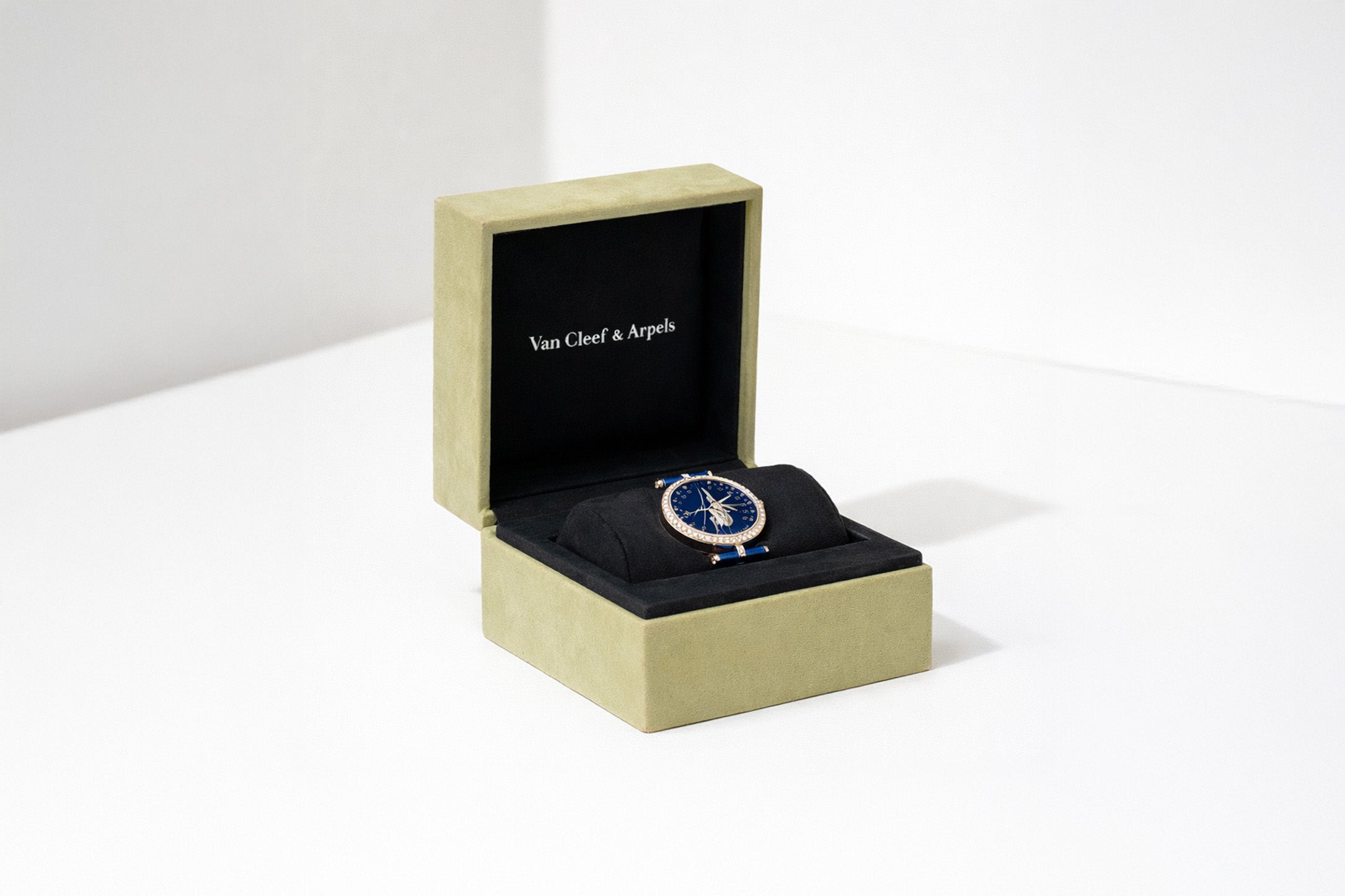
The outer box is white with "Van Cleef & Arpels" in silver and the logo in the corner. The jewelry box is sage suede with a silver VCA logo, lined with black velvet and silver lettering inside the lid.
Older pieces might have different certificates. That’s fine. Missing paperwork doesn’t always mean a piece is fake, especially for vintage items from the '70s to '90s when records were less strict.
Pre-owned sellers should have maintenance records if available. We check serials with Van Cleef & Arpels boutiques, they can confirm authenticity and original purchase details for a fee.
Investing in Pre-Owned: Red Flags to Avoid
If the price is way below market, something’s off. Pre-owned Alhambra bracelets typically trade close to retail, though pricing varies based on condition, material, size, and market demand. Mystery Set pieces and Zip necklaces fetch high prices, so big discounts are a warning sign.
We steer clear of sellers who:
- Won’t provide extra photos of hallmarks or serials
- Can’t explain the piece’s history
- Use stock photos instead of real ones
- Push for a quick sale without inspection
- Don’t offer returns or authentication guarantees
If someone claims a boutique purchase, ask for the original receipt. Van Cleef & Arpels keeps purchase records, so you can check dates and locations.
Watch for mismatched parts, sometimes fakes combine real chains with fake motifs. We check every component, not just one.
If a seller claims “new” condition for a discontinued design, be cautious. Sure, some collectors never wear their pieces, but it’s also a favorite trick for passing off sophisticated fakes in vintage packaging.
Frequently Asked Questions
Perfect symmetry and clean alignment are must-haves for authentic Van Cleef & Arpels. Knowing what to look for helps you spot trouble early and protect your investment.
What are the tell-tale signs of asymmetry to look out for in Van Cleef & Arpels jewelry pieces?
We always start by checking the spacing between motifs. On real pieces, the distance between each clover or design element is perfectly even, down to fractions of a millimeter.
Look at the edges where each motif meets the metal border. The bezel should be the same width all the way around, with no random thick or thin spots, and no gaps between the stone or mother-of-pearl and its frame.
Check the clover leaves or petals. They should all be the same size and shape, and the seams or joins should line up perfectly. Chain attachments should sit centered, not off to one side.
Are there any specific motifs or patterns traditional to Van Cleef & Arpels that are prone to misalignment?
The Alhambra collection gets faked more than any other, so misalignment shows up here most often. The four-leaf clover motif needs four identical rounded sections meeting at perfect right angles in the center.
Vintage Alhambra pieces with lots of motifs on a single chain are especially tricky for counterfeiters, they often mess up the spacing between clovers.
The Perlée line’s beaded edges are tough to fake. Every bead should be the same size and evenly spaced, with no gaps or squished beads.
Can slight misalignments in Van Cleef & Arpels designs indicate a counterfeit item?
Absolutely. Even tiny misalignments are a big warning sign. Van Cleef & Arpels has strict quality control, and real pieces just don’t leave their workshop with visible flaws.
This is a maison that’s been perfecting its craft since 1906. Their artisans train for years to get this kind of precision.
If we see uneven spacing, lopsided motifs, or crooked settings, it’s almost definitely a fake. Real pieces might have microscopic variations only visible under a loupe, but not to the naked eye.
Who do I consult to verify the authenticity of my Van Cleef & Arpels jewelry if I suspect alignment issues?
Start at a Van Cleef & Arpels boutique. Their staff can authenticate and provide documentation if it’s genuine.
Certified jewelry appraisers who know luxury brands are another good option. Look for professionals with credentials from respected gemmological institutes and real experience with Van Cleef & Arpels.
What steps should I take if I discover a misalignment in my Van Cleef & Arpels piece right after purchase?
Contact the seller right away, whether it’s a boutique or a secondary dealer. Take clear, detailed photos in good light from different angles.
If you bought from a Van Cleef & Arpels boutique, the piece is almost certainly real, and the alignment issue should be covered by their guarantee. They’ll repair or replace it.
For pre-owned buys, check the return policy and authentication guarantee immediately. Most reputable sellers have return windows for authenticity concerns. Hang onto all packaging, certificates, and receipts until it’s sorted out.
How can I educate myself about the precision of craftsmanship typical of Van Cleef & Arpels to better spot inconsistencies?
Start by visiting official Van Cleef & Arpels boutiques. Ask if you can handle a few pieces, there’s honestly nothing like seeing the real thing up close. You’ll notice the weight, the way the motifs line up, and the feel of the materials. It’s hard to fake that level of detail.
I’d also recommend scrolling through high-res images on the brand’s website and from authorized retailers. Look closely at the alignment of motifs, the evenness of bezels, and whether the spacing looks consistent. Sometimes, just zooming in on the details can be surprisingly revealing.
It’s worth joining collector communities and forums, too. People often share close-up photos and chat about what to look for when authenticating. Some luxury resellers on social media post side-by-side comparisons of real and fake pieces, those can be eye-opening. The more genuine pieces you handle, the more your instincts sharpen. It’s almost like your hands start to remember what quality feels like.
Love Hermès? See More from Rome Station
Add us to your Preferred Sources on Google to see our newest Hermès guides and insider tips first.