

How to Identify Aftermarket Repairs on Van Cleef & Arpels Pieces
Check out our Van Cleef & Arpels collection!
Van Cleef & Arpels pieces are a real investment, and their value hinges on the original craftsmanship. If you send a piece out for repairs anywhere but an official Van Cleef & Arpels boutique or authorized service center, you risk more than just a mismatched clasp, it can throw off authenticity and tank resale value.
You’ll often spot aftermarket repairs by odd hallmarks, uneven polishing, off-style chains, or clasps that just don’t have that signature “snap” when they close.
Not every repair is a disaster, but the difference between a careful independent jeweler and a shortcut-taker is huge. Some swap out jump rings without the right hallmarks, leave behind ugly solder marks, or use lighter, cheaper chains that don’t feel like solid 18k gold anymore.
Knowing what to check helps you buy smarter, decide on repairs, or just evaluate what’s in your own collection. Details like engraving depth or how a chain moves, these are the things that really separate the real deal from a piece that’s been tampered with.
Key Takeaways
- Aftermarket repairs show up as mismatched hallmarks, inconsistent polishing, and non-original components
- Unauthorized repairs can slash resale value and make authentication a headache
- Official Van Cleef & Arpels service keeps materials, engraving, and craftsmanship up to standard
Why Authenticity and Aftermarket Repair Matter in Van Cleef & Arpels
Aftermarket repairs can wreck a piece’s value, insurability, and even its story. With high jewelry from a house like Van Cleef & Arpels, even a minor unauthorized fix can have big, lasting consequences.
Risks of Aftermarket Repairs for Resale and Value
People pay top dollar for authentic Van Cleef because they trust the brand’s craftsmanship and materials. Once a piece has had aftermarket repairs, that trust is gone.
We’ve seen two identical Alhambra necklaces get wildly different prices just because one had only maison repairs and the other had aftermarket work. The first may retain a significantly higher percentage of its original retail value, while the second often sells at a steep discount.
Repairs that really hurt value:
- Clasps or chains swapped out by non-authorized sources
- Stones replaced with lower-grade gems
- Polishing that erases serial numbers or hallmarks
- Soldering that messes with the original metal
Dealers and auction houses dig into repair history. They know aftermarket work often means someone used 14k gold on an 18k piece or swapped natural stones for synthetics. Collectors don’t overlook these things.
Once unauthorized repairs enter the picture, authenticating gets way harder. Mixed components raise red flags that can make a piece unsellable to reputable buyers.
Insurance and Documentation Implications
Insurance companies base coverage on authenticity and condition, aftermarket repairs mess with both. Most policies want an appraisal from a certified gemologist, someone who checks that the piece is original and unaltered.
If you get a clasp fixed at a random jeweler instead of Van Cleef & Arpels, your insurer might deny future claims. They’ll see it as “altered goods” and question the material quality.
Documentation is huge. Van Cleef keeps service records for pieces sent to their workshops, which creates a provenance trail buyers and insurers love. Aftermarket repairs? No trail, or worse, gaps that make people suspicious.
Appraisers lower values when they spot non-original components, and they have to note these changes, so coverage limits and premiums drop.
Collectability and Heritage
Van Cleef & Arpels isn’t just about luxury, it’s history, especially with iconic designs like the Alhambra from the 1960s.
Collectors see these as investments in heritage. Original condition matters because it preserves the artisan’s intent and the maison’s standards. Once you start mixing in aftermarket repairs, you end up with a hybrid that doesn’t fully represent Van Cleef’s work.
Vintage pieces especially take a hit. A 1970s Alhambra bracelet in untouched condition? That’s a treasure. But swap out motifs or clasps, and it’s just another bracelet.
Museums and estate sales draw a hard line between maintained and altered. The original tells a true story about high jewelry’s evolution; the altered piece? It’s a tale of shortcuts and lost value.
Signature Craftsmanship: What Makes Van Cleef & Arpels Pieces Unique
Van Cleef & Arpels pieces stand out for their precise techniques, top-notch materials, and consistent markings. These factors make their jewelry tough to fake convincingly.
Distinctive Artistry and Maison Techniques
VCA’s workshop methods really set them apart. The artisans use heritage techniques, sometimes spending hundreds of hours on a single piece, especially for high jewelry.
Take the “Pearls of Gold” detail on Alhambra pieces. Each beaded gold border has perfectly uniform, round beads, all the same size and spacing, giving that smooth, continuous texture.
Stone setting is just as strict. Mother-of-pearl, chalcedony, and others are cut to fit each setting exactly, no gaps, no overlaps. Stones should sit flush with the gold, and you’ll notice the right opacity for translucent ones like chalcedony.
Metal finishing is another giveaway. We look for seamless polish, even texture, and perfectly lined-up elements. Authentic pieces don’t have file marks, rough solder joints, or sharp edges, even in the spots you barely see.
Quality of Materials and Construction
Van Cleef & Arpels uses 18 karat gold only, yellow, white, and rose, all 75% pure. White gold gets rhodium plating for shine; rose gold gets its color from more copper.
Diamonds are D to F color, IF to VVS2 clarity, top of the line, though you won’t see those grades stamped on the jewelry.
Material standards:
- Gold: Always 18K, never 14K or 10K
- Platinum: 950 purity, if used
- Diamonds: D-F color, IF-VVS2 clarity
- Gemstones: Only natural, no synthetics
Stone quality is consistent across collections. Whether it’s agate, carnelian, tiger eye, or onyx, you’ll see natural patterns and the right luster. The brand’s selection process weeds out anything that doesn’t meet their aesthetic.
Hallmarks and Serial Numbers
Every genuine piece has three main markings: the brand signature, the gold purity stamp, and a unique serial number. Look for “Van Cleef & Arpels” or “VCA” engraved with sharp, even letters at a consistent depth.
The Au750 or 750 stamp confirms 18K gold and appears with the signature. You’ll find these in specific spots: inside bands for rings, on rectangular plates near clasps for Alhambra necklaces and bracelets.
Serial numbers use letter-number combos engraved as precisely as the hallmarks. You can check these at VCA boutiques or authorized service centers; they tie back to production records.
French pieces show a lozenge-shaped maker’s mark with VC and A beside the Place Vendôme column. For the French market, you might also spot an eagle’s head assay mark, confirming 18K gold purity.
Vintage pieces (1970s–80s) usually have the full “Van Cleef & Arpels” signature with strong serifs; modern ones (post-2000) often use “VCA” in a sharper, more uniform style.
Spotting Signs of Aftermarket Repairs
Aftermarket repairs leave clues that don’t match Van Cleef & Arpels’ factory standards. You can spot these by checking finishing, markings, and whether components are original.
Inconsistent Metal Finishing or Polishing
Van Cleef & Arpels keeps finishing super consistent across every surface. Factory work has even grain and polish, matching perfectly at joints and connections.
Aftermarket repairs usually bring texture changes. You might see one area that’s more buffed or has a different shine. The metal grain can run off in another direction where someone did a fix.
Check solder points and connections on bracelets and necklaces. Factory soldering is nearly invisible; aftermarket work can leave bumps or discoloration. Sometimes the metal around a repair looks overheated or slightly off in color.
Polishing inconsistencies show up under good light. Originals reflect evenly, but repaired spots might look duller or too bright. Tool marks or scratches that shouldn’t be there are another giveaway.
Mismatched Hallmarks or Serial Numbers
Genuine Van Cleef & Arpels pieces have deep, crisp hallmarks with clean edges and even depth. The spacing and alignment are tough to copy.
Aftermarket repairs sometimes mean re-stamped hallmarks, but the replacements usually look shallower, have off fonts, or weird spacing. Compare the clarity and style of all stamped areas.
Serial numbers follow formats tied to production years and collections. If a number’s been altered or re-engraved, it’ll often be a different depth or width. Sometimes you’ll see signs of grinding or polishing where the original number was.
What to check:
- Depth and sharpness of stamps
- Font matches with known authentic pieces
- Metal around the stamps, look for odd wear
- Alignment and placement of marks
Fake pieces sometimes have bad hallmarks from the start, but real pieces with aftermarket repairs might show a mix of genuine and questionable marks where work was done.
Non-Original Components or Clasps
Van Cleef & Arpels uses proprietary clasps and specific component styles for each collection. Original hardware has exact tolerances and a certain weight, aftermarket parts rarely feel right.
Replacement clasps are easy to spot if you check the spring mechanism and how the closure feels. Authentic clasps have a certain tension and a distinct click. Aftermarket ones might feel loose or need more or less pressure.
The mystery setting on some pieces uses a special technique that’s nearly impossible to copy. Replacement stones in aftermarket repairs might sit differently or show prongs or metal that shouldn’t be there. Component sizes matter too, original parts are exact.
Look closely at screws, jump rings, and connectors. Factory parts have consistent machining and finish. Replacements might have different screw heads, slightly off diameters, or lower-quality metal you can spot with a loupe.
Examining Iconic Collections for Alterations
Van Cleef & Arpels’ signature collections have unique construction and design cues, making it easier to spot changes once you know what to look for. The Alhambra collection, launched in 1968, gets altered most often, probably because it’s so popular and people want to resize or tweak these pieces.
Alhambra Collection Specifics
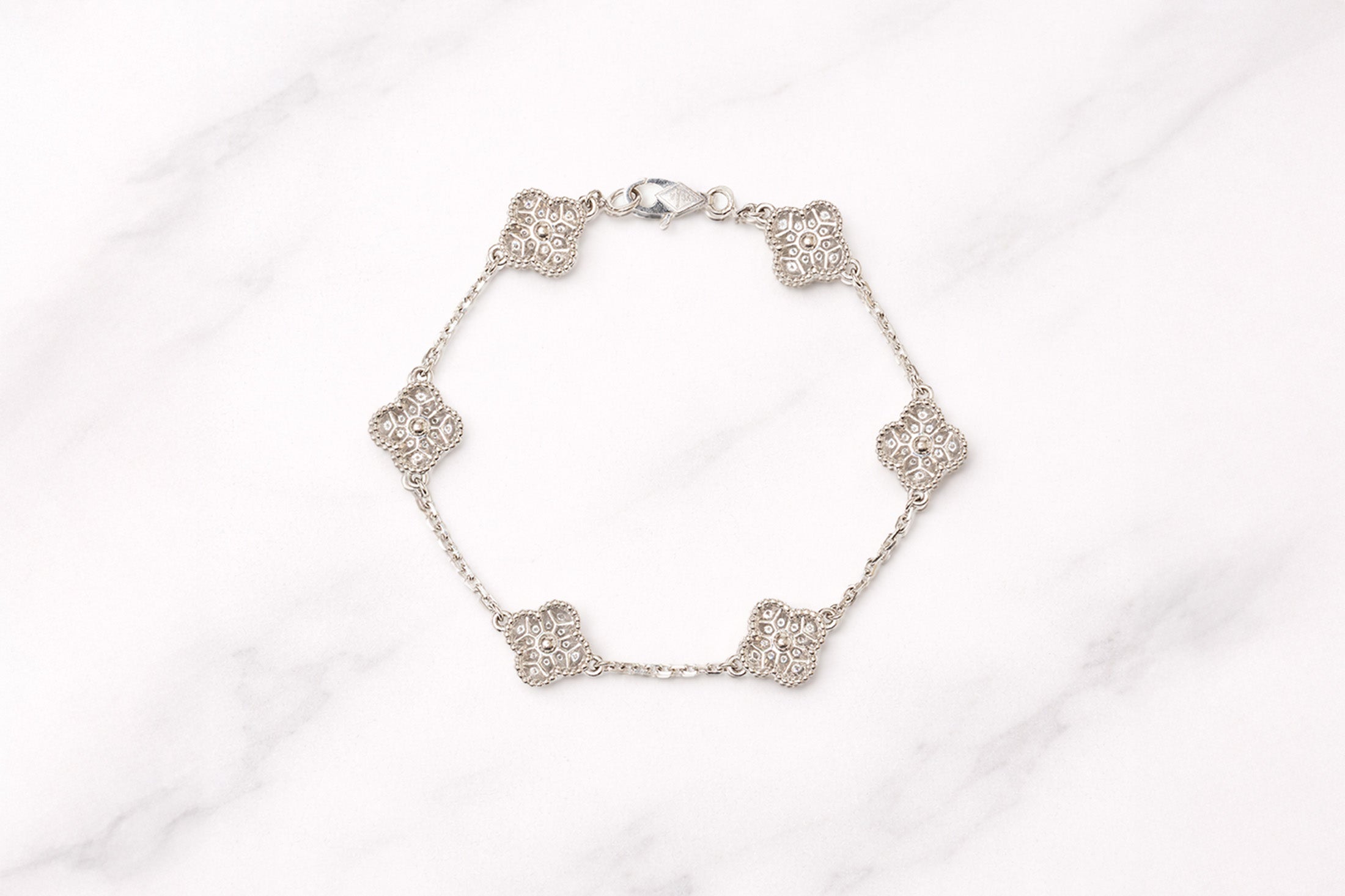
The quatrefoil motif that defines Alhambra pieces has a beaded gold border around materials like mother-of-pearl, onyx, or carnelian. Authentic pieces have perfectly even beading, same size, same spacing. Any irregularity hints at repairs, since mismatched beads or uneven spacing are common after a fix.
The gold backing on each motif should be smooth and seamless. If you see visible seams or slight color differences, it’s likely a replacement. Originals also have specific thicknesses for gold elements, if someone reinforced or swapped parts, those measurements can change.
Chain links on Alhambra bracelets and necklaces are exact in proportion and have a unique oval shape. Replaced chains often use links that are just a bit off in length or width. We measure and compare against authentic specs, even a millimeter’s difference can mean modification.
Sweet Alhambra vs. Vintage Alhambra
Sweet Alhambra motifs are smaller (about 10mm) than Vintage Alhambra’s 15mm quatrefoils. The construction techniques are different, so repairs that mix parts between these lines really stand out.
Sweet Alhambra uses thinner chains and more delicate gold to fit its petite size. Sometimes people try to swap a Sweet motif for a Vintage one, creating an unbalanced look. The weight feels wrong, and the scale is off.
Vintage Alhambra has sturdier builds and thicker gold bezels. The clasps are different too, Vintage usually has heftier lobster clasps. If you spot a Sweet motif with a Vintage clasp (or vice versa), it’s a red flag that parts got swapped somewhere along the line.
Motif Variations and Structural Changes
Original motifs attach to chains with jump rings that match the gold type and finish. Aftermarket repairs? They usually use generic jump rings, sometimes a little off in color or thickness. We look closely at these spots with magnification, searching for solder marks or swapped-out rings.
Stone replacements in Alhambra motifs pop up often. Authentic mother-of-pearl has a certain translucency and grain, Van Cleef & Arpels doesn't just pick anything. Replacement stones usually miss the mark, looking too opaque or showing grain patterns that don't match across the motifs.
Resized Alhambra bracelets sometimes have motifs added or removed. We count them up and check the spacing, since originals keep everything precise. Add a link or take one out and the spacing gets weird, throws off the whole rhythm of the piece.
Proper vs. Improper Repairs: Recognizing the Difference
Van Cleef & Arpels pieces need specialized restoration to keep their structure and value. Amateur repairs? They often cause damage you can't undo, hurting both authenticity and resale. It really comes down to how well the work is done, whether the materials match, and if the original construction logic is respected or not.
Maison-Approved Restoration Methods
The Maison uses techniques developed just for their jewelry. Authorized repairs keep stone calibration exact, preserve original Mystery Set™ frameworks, and use color-matched gold alloys made in-house.
We look for reversibility when checking proper restoration. Van Cleef repairs let future experts intervene without destroying original material or erasing the piece's story. The Maison keeps detailed records of every restoration, photos, material specs, technical notes, the works.
What Maison-approved work looks like:
- Signature placement stays untouched
- Stone settings keep their perfect tension and alignment
- Solder joints are nearly invisible, even up close
- Patina develops evenly across all surfaces
- Any replaced parts have the right hallmarks
When the Maison restores a piece, collectors trust it. They focus on keeping the structure right, not just making it look good on the surface.
Warning Signs of Non-Expert Repairs
Amateur repairs stick out thanks to mismatched materials and shortcuts. You’ll spot wrong solder types, joints with off-color where white gold meets yellow, for example.
You might see tool marks that shouldn’t be there. File scratches, wheel burns, uneven buffing, all signs of rushed work by someone who doesn’t know Van Cleef & Arpels standards. The Maison’s surfaces have micro-beveling and textures you just can’t fake with machines.
Red flags for improper repairs:
| Issue | What It Reveals |
|---|---|
| Overspray or excess adhesive | Sloppy material use |
| Misaligned panel gaps | Bad movement mechanism reconstruction |
| Stone replacement with calibration errors | Off-size or mismatched stones |
| Distorted engraving or signature marks | Too much polishing or refinishing |
| Inconsistent patina | Chemical treatments or harsh cleaning |
Bad repairs erase clues that authenticators use. If someone polishes away too much or uses the wrong alloys, the piece’s integrity is gone for good.
Impact of Aftermarket Modifications on Design Integrity
Unauthorized modifications break the link between Van Cleef & Arpels pieces and the Maison's standards. It's especially obvious with resized rings, jewelers add or remove metal, but rarely keep the original proportions that balance the design.
Aftermarket stone swaps cause permanent authenticity questions, even if the work looks okay. Van Cleef picks gemstones by their own grading, not the usual industry standards. Replacement stones throw off calibration, and trained eyes spot it quickly.
Chain modifications? Another problem. The Maison designs chain lengths and links for specific weight and drape. Change that, and you get odd wear patterns that don’t match authentic Van Cleef pieces.
Clasp replacements with generic parts remove proprietary closure systems, key points for authentication. Even a well-made aftermarket clasp won’t have the exact spring tension, angles, or materials of the real thing.
What To Do if You Suspect Aftermarket Repair
If you think your Van Cleef & Arpels piece has non-authentic work, act fast to check authenticity and protect your investment. The Maison offers official authentication, and independent specialists can help spot unauthorized repairs.
Getting a Maison Authentication
Van Cleef & Arpels boutiques can examine signed pieces and advise on authenticity and service history. You can book an appointment and have their experts examine your jewelry in the right conditions.
They’ll check hallmarks, construction, and materials under magnification. The Maison keeps archives of their creations, so they can verify design elements and manufacturing from different eras.
Bring any paperwork, receipts, certificates, old appraisals. The Maison can tell you if their ateliers did the repairs or if someone else altered the piece. This official check is gold for insurance and resale.
If your piece has aftermarket repairs, Van Cleef & Arpels can tell you if they can restore it to original condition.
Consulting Specialists and Appraisers
Independent jewelry appraisers who know Van Cleef & Arpels can give detailed opinions on suspected aftermarket work. Look for appraisers with credentials in luxury jewelry, not just general gemologists.
These pros use microscopy and metal testing to spot craftsmanship issues. They’ll document things like wrong clasps, odd stone settings, or polishing that doesn’t match the Maison’s methods.
A written report is key for insurance or disputes. It should say what’s been changed and how it affects value and authenticity.
You can find good appraisers through professional groups or auction houses that handle Van Cleef & Arpels often.
Protecting Your Investment
After confirming aftermarket repairs, you’ll need to figure out what it means for your piece’s value and your next steps. Documentation from the Maison or an appraiser is proof if you bought the piece under false pretenses.
If you bought from a dealer or auction house, consumer protection laws or the seller’s authenticity guarantee might help. Many sellers offer returns or compensation if items turn out misrepresented. Check your agreement and contact the seller with your results.
For insurance, update your policy to match the piece’s real condition. Insuring a modified piece as authentic Van Cleef & Arpels is risky and could void a claim.
You might ask the Maison to restore the piece, but only if it’s worth it sentimentally or the value bump justifies the cost.
Frequently Asked Questions
Aftermarket repairs often show up as mismatched engraving depth, off-standard replacement stones, or metalwork that's been resized or resoldered with different techniques. Clasps and closures can give away unofficial work, too, wrong spring tension, altered markings, or parts that just don’t match the originals.
What telltale signs should I be looking for to spot a non-authentic refurbishment on Van Cleef & Arpels jewelry?
Start with the hallmarks. Aftermarket repairs sometimes damage or partly remove original stamps during resizing or setting mods. If the "VCA" signature looks shallow in one spot but deep in another, odds are someone worked on it and tried to re-engrave over their fixes.
Check metalwork under magnification. Originals have a consistent, mirror-like polish everywhere. Aftermarket work can leave matte spots next to shiny ones, or polishing marks going every which way.
Serial numbers can be a clue. If the serial’s crisp but other hallmarks are worn, that’s suspicious. Some shops add fake serials to pieces they’ve heavily modified.
Can the quality of gemstones give away a non-original Van Cleef & Arpels repair job?
Definitely. Van Cleef & Arpels only uses diamonds in the D to F color range, with IF to VVS2 clarity. If your piece comes back from repair with stones that look a bit yellow or have obvious inclusions, they’re not originals.
Mother-of-pearl, onyx, and chalcedony should match in color and shine across all motifs. Sometimes, you’ll see one Alhambra clover a different shade because the repair shop just used what they had.
Stone settings are important, too. Originals have stones that sit flush, no gaps, held by prongs or bezels with identical angles and polish. Aftermarket repairs often mean uneven prongs or bezels that don’t quite match the original.
Are there specific hallmarks or stampings that distinguish genuine Van Cleef & Arpels restorations from aftermarket ones?
Authorized service centers don’t alter or re-stamp hallmarks. If a hallmark looks freshly engraved on an otherwise worn piece, that’s a red flag.
The "750" gold mark should match the VCA signature in depth and style. Unauthorized jewelers sometimes restamp the gold mark but can’t copy the font or depth exactly. Letters might be thicker or the spacing just a bit off.
Genuine restorations keep the original serial numbers. Some repair shops try to add or change serials, but their engraving technique won’t match. Van Cleef & Arpels uses highly precise, standardized engraving methods consistent with the period of production.
How can I tell if the metalwork on my Van Cleef & Arpels piece has been altered by an unofficial repair service?
Ring sizing is a trouble spot. Authorized service keeps the inside band’s perfect curve and uniform thickness. Aftermarket sizing? You’ll often find a flatter spot where metal was added or removed, sometimes with a color change at the solder.
Check the beaded borders on Alhambra pieces. Those tiny gold beads should be perfectly round and evenly spaced. Unauthorized repairs rarely get the beading right, you might see oval beads or gaps.
Solder joints are another clue. Van Cleef & Arpels uses solder that matches the gold alloy, so joints are invisible even up close. Aftermarket repairs often show a color difference at solder points, or you’ll spot file marks where someone tried to blend the joint.
In terms of craftsmanship, what inconsistencies could point to after-market repairs on my Van Cleef & Arpels collection?
Polish quality is usually the first thing that jumps out. Originals have a mirror finish that’s consistent everywhere, even in tight spots. Aftermarket polishing often misses corners or leaves different surface textures.
Stone setting angles matter more than most people think. Van Cleef & Arpels sets stones at the same angle across a piece. Aftermarket jewelers just eyeball it. If one stone sits higher or tilts differently, it’s likely been replaced outside the authorized network.
Edges and corners on genuine pieces are crisp and uniform. We’ve seen pieces where aftermarket repairs left rounded corners on what should be sharp, or the reverse. That happens when repair shops use finishing techniques that don’t match Van Cleef & Arpels’ workshops.
What are the usual giveaways of non-professional repairs when examining Van Cleef & Arpels clasps and closures?
Spring tension just isn’t quite right on clasps that have been tinkered with. Original Van Cleef & Arpels clasps give you this distinct, satisfying resistance, firm, smooth, almost reassuring. If someone’s swapped in a replacement spring or fiddled with the mechanism, you’ll notice it feels oddly loose or maybe way too tight, sometimes even making an unexpected click that the real ones don’t.
Take a close look at the hallmarks on the clasp. Do they actually match the rest of the piece? It’s not unusual for non-professional repairs to involve swapping in a whole clasp from somewhere else, or even using a generic part. You might spot engraving that seems off, maybe the letters are too shallow, or the style just doesn’t match. Sometimes the clasp is missing a serial number that should be there, and that’s a red flag.
Get out a loupe and check the jump rings and connection points. Originals have these perfectly round jump rings, and the closure is almost invisible, like, you’d have to squint to spot it. But on repaired pieces, the jump rings might be a bit oval or you can actually see the gap where it closes. You might even notice a little blob of solder that wasn’t cleaned up properly. Kind of a giveaway, isn’t it?
Love Hermès? See More from Rome Station
Add us to your Preferred Sources on Google to see our newest Hermès guides and insider tips first.