

How to Authenticate Van Cleef & Arpels Necklace Clasps and Connectors
Check out our Van Cleef & Arpels collection!
Van Cleef & Arpels necklaces are some of the most counterfeited pieces in luxury jewelry, and the clasps and connectors are where fakes usually slip up.
Authentic Van Cleef clasps show off precise VCA engravings, deep hallmarks stamped with Au750, and a crisp, satisfying snap that’s tough for counterfeiters to get right. Knowing these details helps protect your investment, whether you’re new to the brand or a seasoned collector.
The tricky part? High-quality fakes have gotten pretty convincing. Many look great in photos but fall apart under close inspection. The clasp, often ignored, is actually one of the best places to spot a fake. It combines engraving, mechanical quality, and metalwork standards that only real experts can pull off.
Let’s break down the markers that set genuine Van Cleef & Arpels clasps and connectors apart from counterfeits. From hallmark placement to the weight and feel of the snap, these practical tips will help you check any Van Cleef necklace with a sharper eye.
Key Takeaways
- Real Van Cleef clasps have deep, centered engravings, and smooth snap mechanisms, no wobble, no grinding.
- Authentic pieces use solid 18k gold marked Au750, with perfectly matched chain links and seamless connector joints.
- Professional authentication services and authorized dealers are your safest bet for high-value Van Cleef jewelry.
Key Authentication Markers on Van Cleef & Arpels Clasps and Connectors
Van Cleef & Arpels clasps have three big giveaways: precise brand engravings, proper metal purity stamps, and unique serial numbers. These appear in the same spots with a level of quality that’s hard for fakes to copy.
Spotting Genuine VCA Clasp Engravings
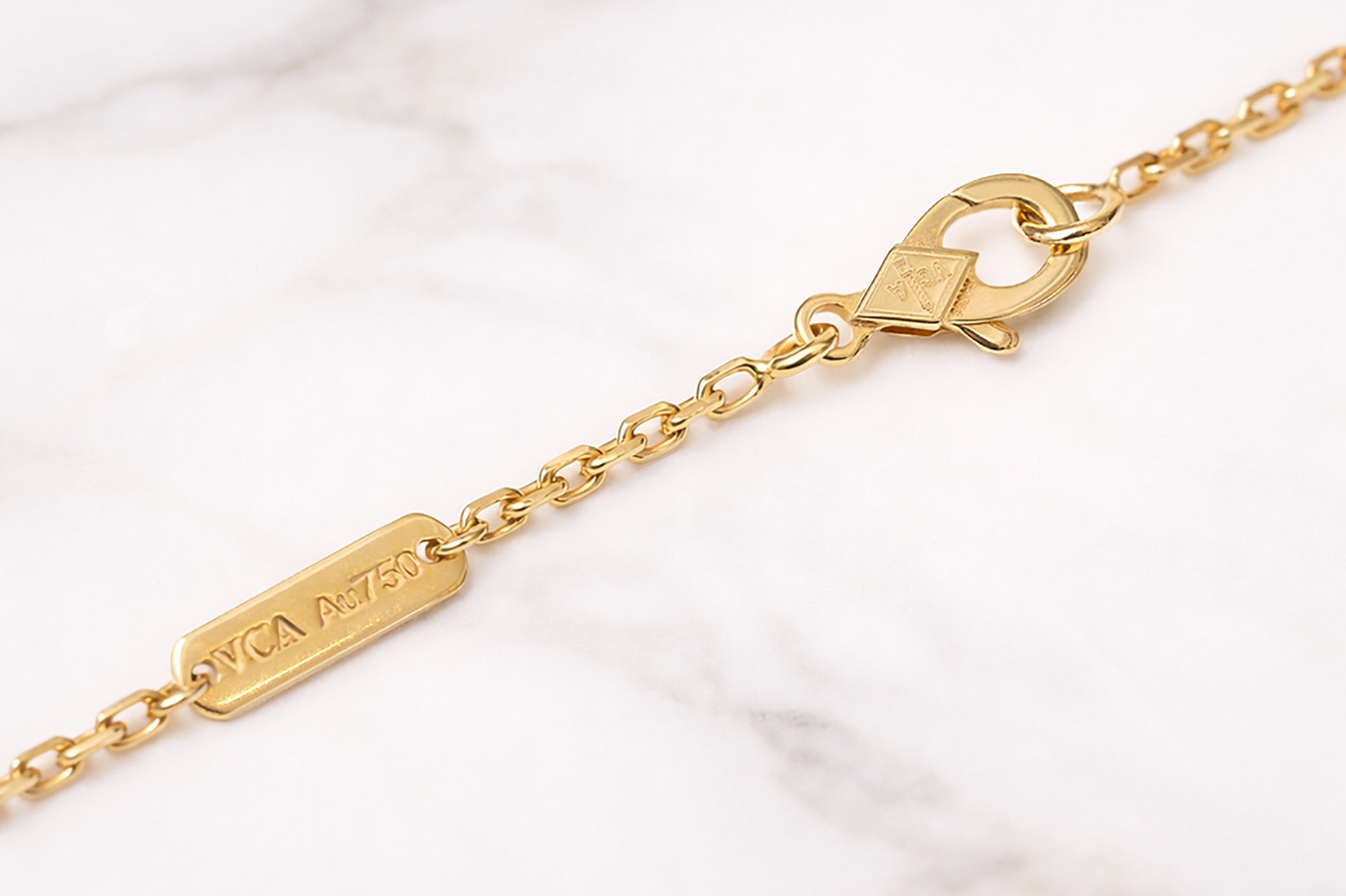
Real Van Cleef & Arpels clasps show either “VCA” or the full “Van Cleef & Arpels” signature, engraved with machine-like consistency. The letters are even, not rough or raised, and when you run your finger across them, they feel smooth.
You’ll usually find the engraving on a small rectangular plate near the clasp or right on it. Each letter has the same depth and sharp edges. Fakes often mess this up, look for uneven spacing, wobbly lines, or stamps that appear to be pressed in, rather than deeply engraved.
See “Van Cleef” without the “& Arpels”? That’s a dead giveaway. The brand never uses partial names.
Analysing Hallmarks and Metal Purity Stamps
The “750” or “Au750” hallmark means 18 karat gold (that’s 75% pure). This stamp sits next to the VCA signature on the same plate, carved with the same precision.
Van Cleef & Arpels sticks to 18k gold. If you see the hallmark '585' (14k) or '417' (10k), the piece is likely not authentic. The stamp should be crisp and clear, not blurry or half-missing.
Some pieces also have the French eagle’s head assay mark, a lozenge-shaped symbol. This shows up on items for the French market or those that meet certain export standards.
Locating and Understanding Serial Numbers
Every real Van Cleef & Arpels necklace has a unique serial number, usually a mix of letters and numbers. You’ll spot it stamped near the VCA signature and purity mark, often on the same plate or an adjacent clasp part.
The serial number’s engraving matches the other markings, same depth, even spacing, and uniform size. You can feel the engraving; it’s not just scratched on.
Van Cleef & Arpels boutiques and authorized service centers can check serial numbers against their records. It’s a smart move for vintage or pre-owned pieces, especially pricier ones.
Alhambra Collection Specifics: Necklaces and Precision Craftsmanship
The Alhambra collection, which debuted in 1968, has its own clasp mechanisms and connector details that change from line to line. Still, every version keeps up strict standards in beading, motif alignment, and metal finishing.
Signature Features of Alhambra Clasps
Genuine Alhambra necklaces use a special ring and bolt clasp system that Van Cleef & Arpels has perfected over the years. The bolt closure slides through the jump ring smoothly, with no catching or resistance.
We’ve noticed real clasps have perfect cylindrical symmetry, no seams or visible solder marks on the bolt. The threading clicks in with precision, taking exactly half a turn to secure. Fakes often have rough threading or need several turns to close, which just feels off.
The jump ring is consistently thick, about 1.2mm for standard necklaces, and connects to the chain with a small link that matches the chain’s size. The clasp hardware always uses the same metal as the necklace, confirmed by the Au750 or other hallmark stamped right on the clasp.
Classic Alhambra Versus Sweet, Magic, and Pure Alhambra
Vintage Alhambra pieces have the largest motifs at 15mm and a heftier clasp to match. The bolt closure is longer (about 12mm) and has deeper threading for security.
Sweet Alhambra necklaces use smaller 10mm motifs and a dainty 8mm bolt clasp. The connector rings here are thinner, about 0.9mm, to keep the look balanced with the finer chain.
Magic Alhambra brings in bigger motifs (up to 18mm) and tweaks the clasp size accordingly. Pure Alhambra skips the beaded borders, which changes how the connectors meet the chain. No matter the style, the clasp works with the same precision, though the size shifts to fit the overall design.
Beading, Motif Symmetry, and Connector Details
The gold beading around each Alhambra motif continues right to the connectors that join clasps and chains to the four-leaf clovers. Authentic pieces show perfectly even beads, all the same size and spaced just right.
We look at the connector rings that attach motifs to chains for certain signs. These rings have a tiny opening that closes flush, almost invisible. The beading on both sides lines up perfectly, without breaking the pattern.
Motif symmetry is crucial at the connection points. Each lobe of the clover matches the others, and when a necklace has multiple motifs, the spacing between them is dead even. Fakes often get this wrong, with uneven gaps or lopsided motifs. The chain links all match in size and shape, and the soldered joints disappear after polishing.
Common Red Flags and Signs of Counterfeit Van Cleef & Arpels
Counterfeit Van Cleef & Arpels pieces often give themselves away with poor clasp construction, uneven stamping, and off-brand font choices.
Detecting Fake Clasps, Chains, and Connectors
The clasp on a real Van Cleef & Arpels necklace snaps closed with a clean, confident click. Fakes often feel flimsy, sticky, or close with an odd wobble that doesn't feel secure.
Check the chain links for consistency. Genuine VCA uses perfectly matched cable links that sit flat and don’t twist or tangle easily. Each link is the same, all the way down.
Connector rings joining motifs to chains should be soldered seamlessly, no gaps or rough patches. Counterfeit pieces usually have messy soldering, with bumps or discoloration at the joints.
Key clasp indicators:
- Feels weighty, not hollow or cheap
- Spring has steady tension
- Moving parts line up perfectly, no gaps
- Metal finish matches everywhere
- No sharp or rough edges
Misaligned or Shallow Stamping
Real Van Cleef & Arpels stamping is always the same depth, with sharp, evenly spaced letters that catch the light just right.
Fake pieces often have stamps that are too shallow, too deep, or all over the place. Letters might sit at odd angles or heights.
Stamp placement matters. On authentic Alhambra necklaces, stamps show up on the clover motif closest to the clasp, centered. Fakes sometimes stick them off to the side or on the wrong part.
Serial numbers on genuine pieces have even spacing and size. Counterfeits often mess up the spacing or make some numbers bigger than others.
Font and Logo Style Inaccuracies
The “VCA” or “Van Cleef & Arpels” stamp uses a specific serif font with fixed proportions. Fakes usually get the font wrong, letters look off, or the serifs are just not right.
The ampersand in “Van Cleef & Arpels” has a unique shape on real pieces. Counterfeits often just use a standard font, missing the mark.
Letter spacing is exact on authentic pieces. The gaps between the words and symbols are measured, and fakes have trouble matching that.
Hallmarks like “AU750” or “PT950” use specific fonts and sizes. If you see odd-looking purity marks or strange terminology, be suspicious.
Material and Setting Quality: What Sets Genuine VCA Apart
Real Van Cleef & Arpels pieces use top-tier materials and show off flawless craftsmanship in their settings and finishes.
Gold Purity, Weight, and Au750 Stamps
Van Cleef & Arpels sticks to 18-karat gold for their fine jewelry. Every piece is stamped Au750 or 750, meaning 75% pure gold.
The stamp needs to be clean and even, with consistent depth. Fakes often have shallow, uneven, or badly placed stamps.
Weight is a big deal. Authentic VCA necklace clasps feel solid, they’re made from real 18k gold, not hollow or filled. If a clasp feels weirdly light, that’s a warning sign.
Metal quality goes beyond the stamp. Real pieces have consistent color, whether it’s yellow, white, or rose gold. Fakes sometimes look off, too shiny, too dull, or just wrong.
Gemstone Settings and Prong Quality
Van Cleef & Arpels only uses top-quality gemstones, checked for color, clarity, cut, and carat. Each stone meets strict standards that fakes just can’t match.
The prong settings are a giveaway. In authentic Alhambra pieces, you’ll see four rounded prongs on one side and four slightly longer prongs on the other, all set by hand. Counterfeits usually have matching prongs with none of this character.
Real prongs sit flush against the stones, with no gaps or rough spots. The metalwork is smooth, even under magnification. Fake settings often look messy, uneven prongs, sloppy soldering, or stones that aren’t held tight.
The beading around Alhambra clovers is another detail. Authentic pieces have the same number and size of beads, applied cleanly. Fakes usually get sloppy here.
Evaluating Overall Polish and Finish
The surface of real Van Cleef jewelry shows their obsession with perfection. Every millimeter is polished, giving a flawless, mirror-like shine.
We check clasps and connectors up close for any tool marks, scratches, or rough spots. Genuine VCA pieces just don’t have these flaws. The finish is smooth everywhere, even in hard-to-reach spots.
Edges and corners get special attention. Real pieces have sharp, clean edges, never rough or sharp enough to snag. Transitions between polished and matte surfaces are seamless.
Even the threaded parts and hinges are finished beautifully. These moving parts work smoothly, with no stiffness or looseness. Counterfeit mechanisms often feel off, too tight, too loose, or just clunky.
Expert Authentication Services and Buying from Reputable Sellers
If you’re investing in Van Cleef & Arpels jewelry, professional verification and choosing the right seller matter. Documentation, trusted sources, and expert appraisals all help make sure you’re getting the real deal.
Importance of Certificates of Authenticity
A certificate of authenticity is your main proof that a Van Cleef & Arpels piece is the real deal. You’ll usually find the serial number, metal type, stone details, and purchase date from an authorised retailer right there.
Original certificates from Van Cleef & Arpels boutiques are still the best. They come with watermarks, official stamps, and exact product descriptions that match your piece down to the last detail.
If you’re looking at pre-owned items without the original paperwork, third-party authentication services can help. Companies like LegitApp, CheckCheck, and Real Authentication have specialists who examine clasps, connectors, and other components to confirm authenticity. Many of them get back to you in under a day and give you formal certificates that work for insurance or resale.
When authenticating Van Cleef & Arpels, experts check serial numbers against company records, and they look closely at engraving quality, clasp mechanisms, and connector construction. This kind of professional verification is especially handy for vintage pieces where paperwork has vanished over the years.
Choosing Trusted Retailers and Boutiques
Official Van Cleef & Arpels boutiques guarantee authenticity, but you’re limited to what’s currently available. For pre-owned pieces, it’s best to stick with established luxury jewellery dealers who have a solid reputation and clear authentication processes.
Trustworthy sellers provide close-up photos of clasps, connectors, engravings, and serial numbers before you buy. They’ll answer detailed questions about construction and have clear return policies if you have doubts about authenticity.
If a seller won’t share close-up images, dodges questions about the piece’s history, or tries to rush you, that’s a red flag. Online marketplaces are even trickier, authenticating Van Cleef & Arpels from photos alone isn’t easy, even for experts.
Look for dealers who specialise in signed jewellery and work with authentication services. They’ll usually have their own certificates and back up their inventory with solid guarantees.
Professional Appraisal and Resale Value
An independent appraisal from a certified gemologist protects your investment. These assessments document your piece’s current market value, condition, and authenticity for insurance.
Professional appraisers check clasp function, connector wear, and overall condition, along with verifying authenticity. They give you detailed reports that note any repairs or issues that could affect value. Getting an appraisal every few years isn’t a bad idea, since the market changes.
Resale value hinges on documentation. Pieces with original certificates, boxes, and professional authentication reports fetch higher prices. Vintage Van Cleef & Arpels in top shape with complete provenance can go up in value, so keeping everything together makes a difference.
Authentication services usually cost $30 to $100, a small price when Van Cleef & Arpels pieces sell for thousands. It’s a bit of peace of mind, whether you’re buying, insuring, or selling.
Comparison With Other Luxury Jewellery Brands
Van Cleef & Arpels sits alongside other luxury houses, but each brand has its own authentication quirks. Hallmarks and clasp engineering really show how much these brands care about both craftsmanship and fighting counterfeits.
Hallmark and Serial Number Differences: VCA and Cartier
Van Cleef & Arpels stamps “VCA Au750” on their 18k gold pieces, usually on a small plaque near the clasp. The engraving is deep and crisp, with letters that stay consistent. Cartier does it differently, stamping “Cartier” with purity marks and serial numbers right onto the jewellery.
The placement isn’t the same either. VCA puts the serial number on the jump ring or clasp, while Cartier often hides it inside pendants or on chain links. Both brands offer certificates with matching serials, but VCA’s certificates list boutique details and purchase dates, Cartier doesn’t always do that.
Luxury jewelry houses often have unique approaches to serial number formats, with VCA's typically being longer and alphanumeric, compared to Cartier's shorter format. VCA uses a fine, delicate engraving; Cartier’s is bolder and pops more under a loupe.
Signature Clasp Construction in Luxury Necklaces
Van Cleef & Arpels clasps show off their tower logo and “VCA” lettering, with a spring mechanism that snaps shut with a satisfying sound. The tongue sits flush, and there’s no side-to-side play. Cartier often uses lobster or ring clasps, engineered just as precisely but with a different feel.
Weight says a lot. VCA clasps feel hefty because they’re solid gold, not hollow like fakes. Cartier’s clasps have that same weight, though some collections look sleeker.
Both brands engrave their logos on the clasp parts, but VCA’s tower icon is sharp even at a tiny size, while Cartier’s script flows in that classic font. You won’t find rough edges or mushy closures on real pieces from either house.
Frequently Asked Questions
Authentic Van Cleef & Arpels clasps have hallmarks like Au750 and VCA engravings, with precise placement and depth. Real connectors have even weight and seamless soldering. The serial numbers are deeply engraved and evenly spaced, and the clasp should click shut with a satisfying snap, fakes rarely get that right.
What marks should I look for on a genuine Van Cleef & Arpels necklace to confirm its authenticity?
Start with the Au750 hallmark, it means you’ve got 18k gold. It should be on the metal tab or jump ring near the clasp, deep enough to feel with your nail.
The VCA signature is key too. Newer pieces show “VCA” with a little tower icon; older ones might spell out “Van Cleef & Arpels.”
These engravings should have crisp edges and even depth. If the letters are shallow, vanish at certain angles, or look laser-etched, something’s off.
French hallmarks like the Eagle or Dog’s head might show up, especially on vintage pieces. These confirm gold content and origin.
How can I tell if the clasp on my Van Cleef & Arpels necklace is the real deal or a clever fake?
The clasp is usually a giveaway. A real Van Cleef & Arpels clasp snaps shut with a solid click and stays closed with no wiggling.
Try opening and closing it a few times. The spring action should feel smooth and reliable, not sticky or loose.
Logo placement matters. Newer Vintage Alhambra pieces have a diamond-shaped plate on the lobster clasp with the VCA logo perfectly centred. If it looks off, too big, or weirdly shaped, it’s probably fake.
Check the weight. Real clasps feel hefty because they’re solid gold; fakes feel light or tinny.
Can you clue me in on the typical weight and feel of authentic Van Cleef & Arpels necklace connectors?
Genuine connectors have a nice heft from solid 18k gold. The necklace should feel substantial but not uncomfortable or flimsy.
The chain should drape smoothly and lay flat. If connectors bunch up or make the chain hang weird, that’s a red flag.
Listen to the metal. Real pieces make a soft, muted sound when you move them, not a high-pitched clink like cheap metal.
The finish is mirror-smooth. If you run your finger along the connectors, they should feel seamless, almost glassy, with no rough spots.
Are there any go-to strategies for spotting a counterfeit Van Cleef & Arpels necklace just by examining its clasp mechanism?
Check the solder points where the clasp meets the chain. Authentic pieces have seamless joins, no gaps, lumps, or extra metal.
The spring inside the lobster clasp should have steady tension. Fakes often use cheap springs that stick or don’t close right.
If there’s a diamond-shaped plate, its edges should be crisp and the surface perfectly polished. Fakes usually have rounded edges or uneven polish.
Test the clasp a few times. A real one works the same every time; fakes feel inconsistent or resist differently with each use.
What subtle details on Van Cleef & Arpels clasps and connectors might giveaway an imitation piece?
Jump rings connecting the chain to motifs are a common weak spot for fakes. Real Van Cleef & Arpels rings are perfectly closed with invisible solder seams, counterfeits show gaps or obvious joins.
Alignment matters. On genuine pieces, all text is straight and centred, with even spacing. If the serial or hallmark looks crooked, be wary.
Check the metal thickness. Genuine connectors keep the same gauge throughout; fakes sometimes look thinner or uneven.
The polish around moving parts says a lot. Real pieces have a mirror finish inside and out, while fakes often skimp on areas you’re less likely to inspect.
Could you give me the scoop on serial numbers and hallmarks that should be present on authentic Van Cleef & Arpels necklace hardware?
Every genuine piece sports a unique serial number, engraved on the metal tab near the clasp, right beside the Au750 hallmark. You’ll notice the characters, they’re deeply carved, with crisp edges and even depth.
When I check these, I look for machine-made engraving, not anything that looks hand-scratched. Those numbers should line up straight, with spacing and width that just feel... intentional.
You can always reach out to Van Cleef & Arpels to see if a serial number matches their records. They keep a database of every item sold through their boutiques, which is pretty reassuring if you ask me.
Older pieces might show a slightly different stamp layout, sure, but you’ll still find both the trademark and the metal hallmark. The spot might change depending on the collection, but the engraving quality? That doesn’t slip.
If you grab a jeweller's loupe, check for sharp, defined edges, no fading or half-struck marks. Thin, wobbly, or uneven engraving is a red flag. If it looks off, it probably is.