
Why Original Certificates Matter in Van Cleef & Arpels Consignment
Check out our Van Cleef & Arpels collection!
When you’re consigning Van Cleef & Arpels jewelry, the original certificate isn’t just some fancy paperwork, it’s the line between a smooth, profitable sale and a tough conversation about whether your piece is even real.
Van Cleef & Arpels does offer authentication services, but for very rare or vintage pieces, there could be difficulties, and the brand may not authenticate all items depending on specific conditions. However, they maintain strict protocols for regular items.
The luxury market’s changed a lot. Back in the day, hallmarks and craftsmanship were enough, but now buyers and sellers want documentation that traces back to the original purchase. The Alhambra collection, for example, can hold 80-90% of its value, sometimes even more, but only if buyers trust what they’re getting.
Without the certificate, you’re not just looking at lower offers. You’re in a market where consignment shops and buyers have gotten pretty wary, everyone knows even experts can get fooled by top-tier fakes. So, understanding why these certificates matter? That’s how you protect your investment and get the best return when you decide to sell.
Key Takeaways
- Original certificates are the primary proof of authenticity now that counterfeits are so advanced
- Pieces with certificates sell faster and for more, sometimes a lot more, in the consignment market
- Selling without documentation means lower offers, longer waits, and sometimes outright rejection by reputable shops
Why Certificates Are Essential When Consigning Van Cleef & Arpels
Original certificates play a huge role in how much you’ll get when you sell Van Cleef & Arpels pieces, and they’re what makes buyers comfortable enough to make an offer. Documentation is what separates pieces that fly off the shelf at premium prices from those that just sit there or get discounted heavily.
Proof of Authenticity for Buyers and Sellers
A Van Cleef & Arpels certificate of authenticity is official proof your piece is genuine. It lists details like serial numbers, materials, and the purchase date, stuff that should match the jewelry itself.
We’ve seen consignment deals fall apart simply because sellers couldn't provide the proper paperwork. In the luxury resale world, your word doesn’t cut it, no matter how real your piece looks. Buyers want real, tangible proof.
The certificate protects both sides. Sellers can show they’re offering the real thing, and buyers get the peace of mind they’re not about to drop thousands on a fake. This is especially true for high-value pieces like Alhambra or rare vintage designs, where knockoffs are everywhere.
If you don’t have the certificate, you’ll need third-party authentication. That means extra cost, more waiting, and honestly, more uncertainty for everyone.
Maximizing Consignment Value
Pieces with their original certificates always get better prices on the secondary market. That paperwork verifies the piece’s provenance, eliminating much of the doubt, making buyers more willing to pay more.
Consignment shops and platforms usually put items with full documentation in their premium pricing categories. For example, a Van Cleef bracelet with its certificate might go for 15-30% more than the same piece without papers.
The certificate also confirms your piece hasn’t been altered or repaired somewhere unofficial. Buyers care about this because unauthorized work can hurt both authenticity and value.
When you consign Van Cleef with the certificate, authentication goes quicker. That means your piece gets listed and sold faster, and you don’t have to wait forever for your payout.
Building Trust in the Secondary Market
The luxury consignment world runs on trust, and certificates are a big part of that. They give your listing credibility before anyone even sees the piece.
Most reputable consignment platforms won’t even accept Van Cleef & Arpels jewelry without a certificate. If you don’t have one, you’re left with less strict platforms, which usually means lower prices and fewer serious buyers.
First-time luxury buyers lean on certificates to feel confident about their purchase. They know counterfeits exist, and documentation is what tips the scale for them.
The certificate also acts as a permanent record. Future owners can keep the chain of authenticity going, which helps preserve value and makes future resales a lot less stressful.
Understanding Van Cleef & Arpels Certificates
Van Cleef & Arpels certificates are official documents that verify the authenticity, specs, and origin of your jewelry. They detail materials, gemstones, and unique identifiers, basically, all the info you need to prove your piece is legit and worth what you’re asking.
What Information Is Included
A real VCA certificate spells out the product name, collection (like Alhambra or Frivole), and a full description of materials, gold karat, metal type, gemstones, and their specs.
Serial numbers are a big deal. They’re printed clearly on the certificate and should match the ones engraved on your jewelry. You’ll also see the purchase date, boutique location, and sometimes the original retail price. For pieces with precious stones, there’s usually gem info like carat weight, clarity, and color.
The document itself is marked with the Van Cleef & Arpels logo, address, and security features to prevent fakes. Some certificates even have photos or illustrations of the piece.
How to Identify a Genuine VCA Certificate
Real Van Cleef & Arpels certificates use thick, high-quality paper that feels different from knockoffs. The print is sharp, no blurry logos or smeared ink.
We check for formatting and fonts that match VCA’s usual style. Security features like watermarks, microprinting, or holograms (depending on the era) should be there. The serial number must match your jewelry, down to the last digit.
Genuine certificates are always dated and stamped by an official VCA boutique. If you spot spelling mistakes, weird branding, or sloppy printing, that’s a red flag.
Certificate Versus Other Documentation
Besides the main certificate, Van Cleef & Arpels gives out warranty cards for repairs and servicing. The certificate, though, is what verifies the specs and authenticity. Receipts from boutiques show proof of purchase but don’t include all the details.
Appraisals from outside gemologists tell you the value but aren’t official VCA docs. When you’re consigning, the certificate is what matters most. Boxes, pouches, and care booklets help, but they’re not a substitute for the certificate.
Some older VCA pieces came before the current certificate system, which makes authenticating them a bit trickier.
Authentication Markers Beyond Certificates
If the certificate’s missing, or we’re just double-checking a piece for consignment, we lean on physical markers that are tough for counterfeiters to copy. Van Cleef & Arpels builds in several authentication points, tiny engravings, specific metal stamps, and other details that experts know to look for.
Signatures, Hallmarks, and Serial Numbers
Real Van Cleef jewelry has a VCA signature stamp in exact spots that depend on the collection and type of piece. For Alhambra, you’ll usually find these marks on the back of each motif or on the clasp, not randomly placed.
Most modern pieces have serial numbers, usually on jump rings, clasps, or the backs of pendants. These numbers follow certain patterns based on the year and collection. We’ve seen fakes with serials that look good at first, but the sequence is off or they’re engraved in the wrong place.
There are also hallmarks, sometimes with maker’s marks or country marks. French pieces, for example, often have the eagle’s head stamp for 18-karat gold. These sit beside the VCA signature, and their presence (or absence) tells us a lot about the piece’s origin.
Engraving Quality and Fonts
The engraving on real Van Cleef pieces is super consistent and sharp, almost impossible to fake perfectly. We look at the depth, spacing, and shape of every letter and number, usually under magnification.
The font is a signature serif style, with unique features in letters like ‘A’ and ‘V’. The depth stays even, and the lines are crisp, not rough or blurry. Counterfeits often slip up here, with weird letter spacing, uneven lines, or letters that just look off.
Van Cleef’s engraving method leaves smooth, shiny surfaces inside each letter. If we see grainy or dull finishes, that’s a warning sign.
Gold Purity Marks and VCA Au750
The “VCA Au750” stamp means the piece is 18-karat gold (that’s 75% pure) and you’ll find it on almost all modern Van Cleef gold jewelry. It’s usually near the VCA signature, on clasps, motif backs, or tucked away in subtle spots.
The Au750 mark uses the same precise engraving as the signature. We check for even letter height, correct spacing, and the right font for the time period.
Some fakes just stamp “750” without the “Au,” or put the mark in the wrong place. Others mess up the depth, too deep, too shallow, or uneven.
The Role of Packaging and Presentation in Consignment
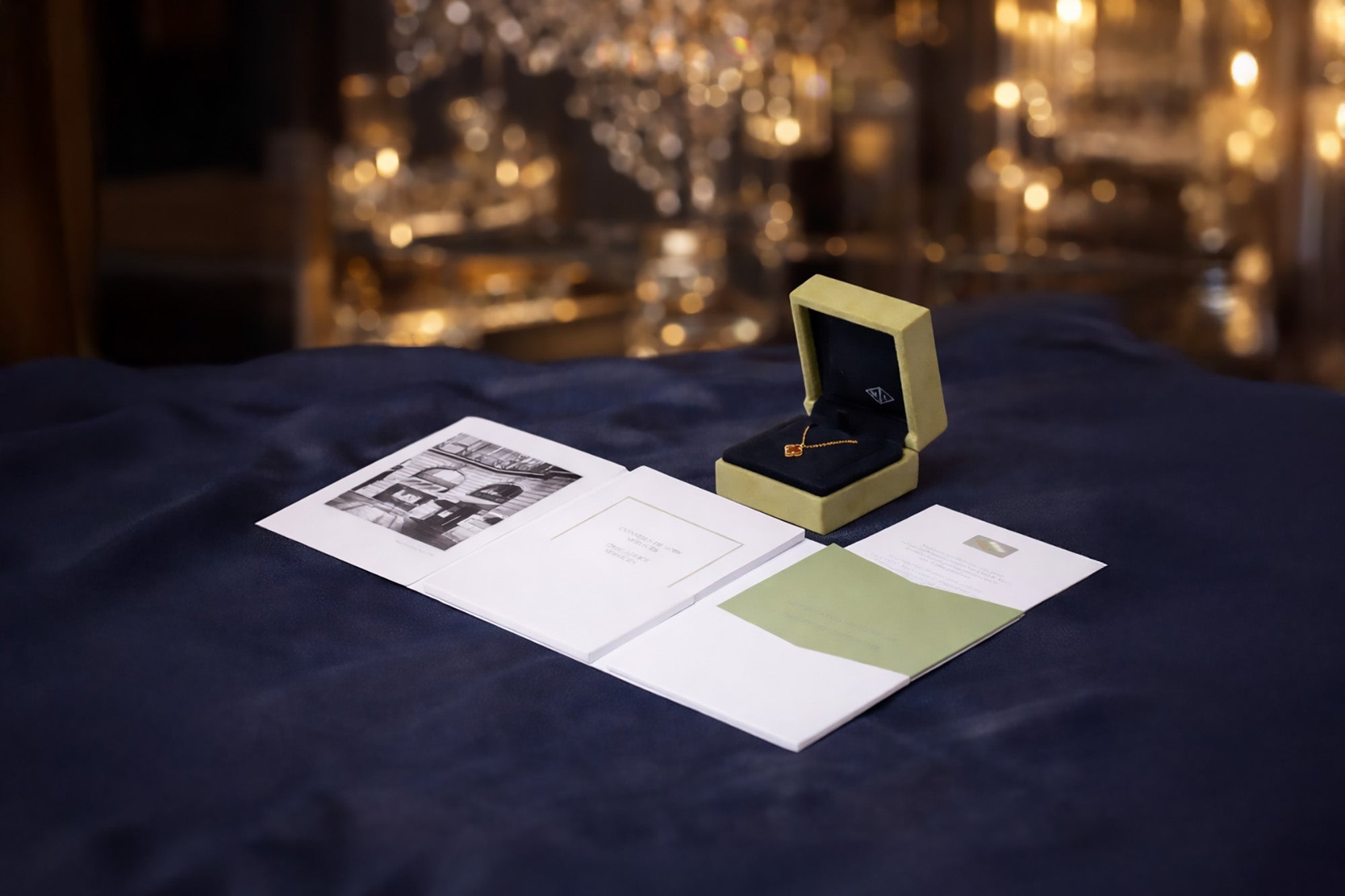
Complete packaging can make a big difference in consignment value and how much buyers trust your piece. The original box, certificate, and accessories from Van Cleef & Arpels aren’t just for show, they help prove authenticity and can bump up the sale price.
Original Boxes and Accessories
Van Cleef & Arpels packaging is crafted with a lot of care, just like their jewelry. Each piece comes in a custom velvet and silk box designed for its collection, whether it’s Alhambra or Perlée.
When we take pieces for consignment, we look for the original box, dust pouch, care booklet, and even ribbons or shopping bags. These show the piece has been well cared for since it was bought.
Boxes have changed over the years. Vintage Alhambra pieces from the ‘70s and ‘80s came in different packaging than what you see now, and collectors notice these details.
Missing packaging doesn’t mean your piece is fake, but it does make authentication a bit more work. We have to rely more on metal testing, hallmarks, and gemstone analysis when the original accessories aren’t there.
Importance for Vintage and Collection Pieces
Vintage Van Cleef & Arpels pieces with their original packaging are pretty rare. Most people tossed the boxes decades ago, so if you have a complete set, collectors will pay a premium.
For discontinued Alhambra designs or limited editions, the original packaging becomes part of the story. It shows the brand’s evolution and how their standards changed over time.
Collectors love vintage pieces with full provenance. A ‘70s Vintage Alhambra necklace with its original box is a big deal, it’s solid proof of where the piece has been.
Packaging also gives clues about when the piece was made. Different hallmark styles, box designs, and certificate formats help us pin down the age and confirm authenticity.
Buyer Perception and Final Sale Price
Complete packaging usually adds 15-30% to the final sale price in luxury jewelry consignment. Buyers see a fully packaged piece as better cared for and, honestly, just a safer bet.
Presentation matters, especially in the high-end market. When someone opens a Van Cleef & Arpels Alhambra piece in its original velvet box, it feels like a boutique experience, makes the price feel more justified.
We’ve noticed pieces from popular lines like Perlée sell faster with original packaging. Buyers can gift these right away, which widens the pool of interested customers.
For collectors who care about investment, keeping all the original bits protects future resale value. They know that having everything together keeps the piece worth as much as possible when it’s time to sell again.
Market Impact: Certificates and Investment Value
Original certificates have a direct effect on how Van Cleef & Arpels pieces do in the resale market. Documented pieces typically fetch 15-25% more than identical items without paperwork. That authentication isn’t just about legitimacy, it’s a big selling point for buyers looking to invest in pre-owned jewelry.
Collection Value Retention
The Alhambra collection holds onto 80-90% of its original retail value when it comes with all its documentation. We’ve seen pieces with certificates, boxes, and service records consistently beat out undocumented ones at auction or through consignment.
Mother-of-pearl and onyx Alhambra pendants are especially strong sellers. A vintage Alhambra necklace with full documentation can actually go for more than it originally cost, especially if it’s got rare materials or old clasp styles collectors love.
Service records help too, they show the piece has been cared for. Buyers trust a piece more when they see official Van Cleef & Arpels service paperwork, and they’ll pay for that peace of mind.
Desirability in the Alhambra and Perlée Lines
The Magic Alhambra collection is always in demand, especially two-motif and three-motif pieces. Certificates are a must for these high-value items, buyers dropping $8,000-$15,000 want to be sure they’re getting the real deal.
Perlée pieces with documentation move 20-30% faster than those without. The intricate beading on Perlée bracelets and rings makes them tough to authenticate without paperwork, so certificates help buyers feel confident and close the deal quicker.
Limited editions and seasonal colors in both collections need certificates to prove authenticity and the release year. A carnelian Alhambra pendant or a turquoise Magic Alhambra? If you want buyers to know it’s not a reissue, you’ll need the paperwork.
Comparisons with Cartier and Other French Brands
Van Cleef & Arpels documentation matters just as much as Cartier's certificate system. Still, Van Cleef pieces, especially from the Alhambra line, tend to keep their value more reliably than Cartier's standard Love or Juste un Clou. Both brands have a loyal following and solid authentication routines.
Cartier resells faster thanks to its wider distribution, but Van Cleef & Arpels usually fetches higher prices when vintage pieces come with proper documentation. A certified vintage Alhambra can edge out a similar-era Cartier by about 10-15% at sale.
Other French luxury names like Boucheron and Chaumet just don't compete on resale power. For them, paperwork barely moves the needle. The Van Cleef certificate, on the other hand, really matters because the brand has built up such a strong collector base and stable market over the years.
Selling Without an Original Certificate: Risks and Strategies
Trying to sell Van Cleef & Arpels jewelry without the original certificate? That's tough. The lack of documentation drags down both the price and buyer trust, but you do have a few ways to soften the blow.
Potential Value Loss
From what we've seen, pieces missing their original certificates usually sell for 20-35% less than identical ones with full paperwork. That drop comes from buyers worrying about fakes, and let's face it, counterfeits are getting better every year. It's an especially big hit for high-value pieces like those from the Alhambra line or rare vintage items.
Consignment shops and auction houses get pickier with undocumented jewelry. Some luxury consigners won't even touch Van Cleef & Arpels without certificates, which means fewer places to sell. If they do take it, they often subtract authentication fees from your payout, so you walk away with even less.
Selling without documentation also drags out the process. Buyers want more photos, close-ups of hallmarks, maybe even their own expert to check things over. It's a slower, more stressful deal all around.
Options for Independent Authentication
Several specialists focus on authenticating Van Cleef & Arpels. It's smart to look for appraisers who really know the brand's signatures, hallmarks, and how their designs have changed over time.
If your piece has major gemstones, labs like GIA can certify the stones themselves. That won't replace Van Cleef's original paperwork, but it does confirm the quality of the materials. Expect to pay anywhere from $200 to $800 for authentication, depending on how complicated the piece is.
Some Van Cleef & Arpels boutiques offer authentication for vintage jewelry, but policies vary. Sometimes they'll issue a letter confirming authenticity after checking their records and examining the construction, serial numbers, and hallmarks unique to their workshops.
Recommendations for Consignors
Before you try to sell Van Cleef & Arpels jewelry without certificates, gather up any paperwork you can find. Old receipts, insurance appraisals, even photos of the piece with its original box, these all help reassure buyers and can take a little sting out of missing certificates.
Pick consignment partners who know Van Cleef & Arpels inside and out. General luxury jewelry platforms just don't have the same eye for detail. Specialists understand what buyers are looking for, and they can explain authenticity markers with more authority.
Decide if professional authentication is worth the cost. For jewelry valued over $5,000, spending a few hundred dollars could help you recover a big chunk of that 20-35% discount. For cheaper pieces, it might not be worth it.
Frequently Asked Questions
Original certificates really do shape resale value and buyer confidence. Without them, getting a fair price and a smooth consignment gets a lot trickier.
What's the big deal about having the original certificates when I consign my Van Cleef & Arpels pieces?
Original certificates tie your jewelry directly to Van Cleef & Arpels' records. They show serial numbers, metal content, and gemstone info that match your piece.
Without them, you're basically asking buyers to trust a physical inspection alone. That's a tough ask, especially with so many convincing fakes out there.
Certificates also prove provenance, which is a huge deal in luxury resale. Buyers want to know they're getting the real thing, and paperwork settles those nerves faster than anything else.
Can I expect a higher price for my jewelry consignment if I provide the original certificates?
Absolutely. Jewelry with full documentation often brings in 15-25% more in the consignment market. Buyers pay more for the peace of mind that comes with official paperwork.
We've watched nearly identical Alhambra necklaces sell for wildly different prices, just because one had the certificate and the other didn't. The documented piece always wins.
Think about it: if two buyers are eyeing your vintage Van Cleef bracelet, but only one sees full paperwork, which one do you think will make the stronger offer?
How does the authenticity of my Van Cleef & Arpels jewels get verified without the original certificates?
We focus on physical details, hallmarks, serial numbers, clasps, and the overall craftsmanship. Authenticators check metal purity stamps, stone settings, and the brand's signature techniques.
Van Cleef has its own manufacturing quirks. We look for the VCA hallmark, the French eagle stamp for gold, and other marks that change depending on when the piece was made.
Professional authenticators use magnification to check tiny details that fakes usually miss. Stone quality, metalwork, and construction all tell a story, but this takes more time and costs more than just verifying a certificate.
What should I do if I've lost the original certificates for my Van Cleef & Arpels collection before consignment?
Try reaching out to Van Cleef & Arpels with your piece's serial number and purchase info. They keep records and might issue replacement documents, though older pieces are a long shot.
If you bought from an authorized dealer, they could have sales records that help. Even partial paperwork is better than nothing.
Consider getting a professional authentication report. It's not the same as the original certificate, but a detailed third-party assessment still boosts your credibility with buyers.
Are buyers really willing to pay more for Van Cleef & Arpels items with original paperwork?
No question about it, the numbers back it up every time. Documented pieces sell faster and attract more serious buyers.
Collectors, especially those looking at the Alhambra line, won't even consider items without certificates. They're building collections for both enjoyment and investment, so paperwork is non-negotiable.
We've watched certified pieces spark bidding wars, while similar items without documents just sit. It's basic supply and demand, when buyers know they're getting the real thing, they're willing to pay for it.
How can I prove the value of my Van Cleef & Arpels pieces for consignment without the certificates?
A professional appraisal from a certified gemologist goes a long way, they’ll check out the metal, the stones, and the overall craftsmanship, then give you a value based on what’s happening in the market right now.
If you’ve got purchase receipts, hang on to those. Even if you’re missing the official certificates, receipts show you bought the piece and what you paid. Insurance paperwork can help too, since it usually lists the insured value and gives some history of your ownership.
We also look at recent sales of similar, authenticated pieces to get a sense of the going rate. But, honestly, without the certificates, we usually set prices about 15–20% lower than fully documented ones. It’s not ideal, but it helps bridge the authentication gap and makes the piece more appealing to buyers who don’t mind skipping the paperwork.