


Identifying Van Cleef & Arpels Vintage vs. Modern Pieces Accurately
Check out our Van Cleef & Arpels collection!
Van Cleef & Arpels has been making jewelry for well over a century, and being able to tell the difference between vintage and modern pieces matters if you're collecting or buying.
Authentic vintage pieces usually show hand-finishing, era-specific maker’s marks, and design quirks of their time, while modern pieces reflect current production methods and branding.
It’s not just about age, there are details in craftsmanship, materials, and little authentication markers that set a 1970s Alhambra apart from a recent reissue.
There’s a lot of confusion out there. Sometimes, people mistake modern pieces for vintage, or worse, get fooled by fakes.
Spotting the clues from each era helps you avoid overpaying or being misled. Clasp styles, gold alloys, and even small design tweaks all hint at when and how a piece was made.
If you’re eyeing your first Van Cleef piece or adding to a collection, knowing these tells lets you make smarter choices.
Let’s go through the main signs that set vintage apart from modern, and what to keep in mind with reissues and copies.
Key Takeaways
- Vintage and modern Van Cleef pieces differ in hand-finishing, maker’s marks, and design details unique to their era
- Authentication means checking clasps, gold content, signature motifs, and specific craftsmanship clues
- Knowing these differences helps collectors avoid overpaying for reissues or buying fakes
Fundamental Differences Between Vintage and Modern Van Cleef & Arpels
Van Cleef & Arpels pieces from different decades carry their own design language, materials, and construction, reflecting both style trends and the tools of their time.
Era-Defining Style Signatures
Vintage VCA, especially from the 1920s through the ‘70s, is bold and sculptural. Think chunky gold, big curves, and lots of three-dimensional detail, all painstakingly made by hand.
You’ll see visible metalwork and hefty settings that really show off the jeweler’s skill. The Mystery Set, launched in 1933, is a classic example, most jaw-dropping in mid-century haute joaillerie.
Modern Van Cleef & Arpels? It’s sleeker and more refined. The Alhambra collection today is all about streamlined shapes and easy wear. The focus is more on versatility and everyday elegance, though the Maison still does wild, one-off high jewelry for special clients.
Material Choices by Period
Vintage pieces lean heavily on yellow gold, a favorite from the early 20th century up through the ‘70s. You’ll also spot more carved stones, coral, turquoise, lapis lazuli, especially in ‘60s and ‘70s designs.
Modern VCA has broadened the palette. White and rose gold are now everywhere, and materials like onyx and grey mother-of-pearl show up in newer collections. Stones are still top-notch, but modern technology brings more uniform cuts and calibration.
How Designs Have Evolved
The way VCA jewelry is made has changed a lot. Vintage pieces have hand-finishing marks and tiny quirks, proof they’re handmade. Old clasps are simpler, often a bit chunkier.
Modern pieces use computer-aided design and high-precision manufacturing, but they still get a traditional hand-finish. Clasps today are engineered for security and smoothness. Even the Alhambra motif itself has changed since 1968, now it comes in more sizes and versions, tweaked for today’s tastes but still true to the original vibe.
Signature Motifs and Iconic Collections
Van Cleef & Arpels has built its reputation on motifs you can spot from across a room. The Alhambra’s four-leaf clover has been reimagined many times, and Frivole brought in a softer, floral look that’s changed in subtle ways over the years.
Alhambra and Its Generations
The Alhambra debuted in 1968, showing off that signature quatrefoil clover. Vintage Alhambra pieces have beaded gold borders and simple, classic lines. The standard motif is about 15mm, but there are a few size variations.
Over time, the line expanded, more materials (onyx, carnelian, mother-of-pearl, malachite), same hand-applied beading along the edges. This detail takes real skill.
Modern Alhambra sticks to these basics but mixes in new stones and finishes. You’ll notice differences in clasps, chains, and the crispness of the beading. Vintage pieces often feel a bit heavier or different in the hand, manufacturing methods have changed just enough to make a difference.
Evolution of Frivole Pieces
Frivole launched in 2003 with a delicate, blooming-flower motif. Where Alhambra is geometric, Frivole is all soft petals and a central stone.
Early Frivole pieces had more pronounced, curved petals, lots of movement and light play. Diamonds were set and petals angled in ways that shifted over time, so newer pieces catch the light a bit differently.
Modern Frivole uses setting techniques that just weren’t possible in the early 2000s. Petals are more uniform, stones are set tighter. You really see it when you compare earrings or rings from different years, the dimensional look changes.
Magic Alhambra vs. Sweet Alhambra
Magic Alhambra has a bigger motif (about 18mm), so it’s bolder than Vintage Alhambra. This line often puts gemstones on both sides of the pendant, so you can wear it either way.
Sweet Alhambra is the daintier version, around 11mm. It’s perfect for people who like subtle jewelry. Usually, Sweet pieces use just one stone type instead of mixing materials, keeping things simple.
Both have that signature beaded gold border, but the scale changes the look and feel. Magic Alhambra is for those who want their jewelry to stand out; Sweet Alhambra works well for layering or everyday wear.
Materials and Craftsmanship Cues
Van Cleef & Arpels has always set the bar high for materials, but how they finish and assemble their pieces has evolved. Looking at gold alloys, stone choices, and diamond settings can tell you a lot about when something was made.
Gold Standards: 18k Markings
Van Cleef & Arpels has stuck with 18k gold for almost everything since the start. Vintage pieces from the 1920s to the ‘70s usually show French hallmarks, like the eagle’s head for 18k, and maker’s marks that change with the decade.
The gold itself is a clue. Vintage pieces often have a warmer, richer yellow, older alloy recipes, before things got standardized. Modern pieces are more consistent in color, whether it’s white, yellow, or rose gold.
If you look closely, vintage gold work often has tiny surface irregularities. These aren’t defects, they’re the marks of hand-finishing. Modern pieces are smoother, thanks to advanced polishing, but VCA still does a lot by hand.
Gemstone Choices: Onyx, Mother of Pearl, and More
The Maison has always loved certain stones. Onyx, mother of pearl, and lapis lazuli pop up a lot, especially in Alhambra since its 1968 launch.
Vintage stones show more natural variation, color, pattern, even a bit of age in mother of pearl’s glow. Cutting and setting methods differ too.
Modern stones are cut with lasers, so thickness and iridescence are super consistent. Today’s lapis lazuli is reliably deep blue with evenly spread pyrite, while vintage versions might be more varied.
Pearls have changed too. Vintage pieces often used natural pearls with slight quirks in shape and shine. Modern collections mostly stick to cultured pearls, more uniform in size and surface.
Diamond Selection and Mounting Methods
Van Cleef & Arpels’ diamond choices say a lot about when a piece was made. Vintage pieces from the ‘20s to ‘60s have old European, old mine, and transitional cuts, chunkier, different facets, larger culets.
Modern pieces use round brilliant cuts, cut to maximize sparkle. The standards for clarity and color are higher now, so modern diamonds tend to be a notch above most vintage ones.
Mounting is another giveaway. Vintage settings often show hand-shaped prongs and bezels, look close and you’ll see tiny asymmetries. The Mystery Set technique, from 1933, appears in both old and new pieces, but vintage ones may have small gaps between stones. Modern settings, thanks to CAD and better tech, fit stones in tighter and more precisely.
Authenticity Indicators Unique to Each Era
Van Cleef & Arpels marks and builds their pieces differently depending on the decade. Knowing what to look for helps you spot true vintage, modern originals, and fakes that try to copy either.
Serial Number Engravings Over Time
Vintage VCA from the ‘60s to ‘80s usually has short serial numbers (4–6 digits), engraved with fine, neat strokes. The engraving is always clean and consistent, not stamped or punched.
Modern pieces, starting in the ‘90s, have longer alphanumeric serials (letters and numbers). The engraving is still crisp, but you’ll see more complex codes, reflecting computerized tracking. Placement of the serial number shifted too; vintage pieces sometimes hide them in less obvious spots, while modern pieces are more standardized.
If you want to check a serial number, you can contact a Van Cleef & Arpels boutique, but they’ll probably need to see the piece. Fakes often have thicker, uneven numbers that look stamped, no matter which era they’re pretending to be.
VCA Hallmarks and Stamp Locations
Real pieces always say "Van Cleef & Arpels" or "VCA", never just "Van Cleef." Vintage from the ‘50s–‘70s usually spells out the full name, but the VCA abbreviation took over in later years.
Stamp location changes too. Vintage bracelets might hide marks inside clasps or on jump rings, while modern Alhambra pieces put them on chain links near the clasp. Metal purity marks (750 for 18k) sit next to the maker’s mark; French pieces add the eagle’s head or other assay marks.
| Era | Typical Stamp Format | Common Locations |
|---|---|---|
| 1950s-1970s | Full name | Clasp interior, jump rings |
| 1980s-1990s | Mixed (full/VCA) | Moving to chain links |
| 2000s-Present | VCA abbreviation | Consistent chain link placement |
Clasp and Closure Innovations
Vintage Van Cleef pieces use different clasps than today. Older Alhambra bracelets might have lobster or bolt ring clasps, while new ones feature the brand’s proprietary closures with a smooth, precise feel.
Quality’s always there, but modern clasps are more secure and ergonomic. Vintage closures feel solid and show honest wear from years of use. Modern ones snap shut with flawless tension and perfect alignment.
Fakes usually mess up the clasp. You’ll see modern clasps on supposed vintage pieces (which doesn’t make sense), or stiff, badly made closures on fake modern pieces.
Spotting Modern Reissues Versus True Vintage
Modern reissues can look nearly identical to vintage, but reference numbers and original packaging are often the real giveaway for when a piece was made.
Reference Numbers and Documentation
Van Cleef & Arpels started using systematic serial numbers in the 1970s, and these codes can reveal manufacturing dates and authenticity details. True vintage pieces from the 1960s and earlier often don't have serial numbers at all, which is just how it was back then. If you spot a serial number, check it against the style and design features to see if they line up with the era the seller claims.
Modern reissues have up-to-date serial numbers that show recent production years, even if they mimic vintage designs. A certificate of authenticity from a Van Cleef & Arpels boutique will state the purchase date and help you figure out if you’re looking at an original or a reissue. Sometimes sellers claim a piece is vintage, but the serial number format alone gives away that it’s much newer.
Documentation varies by era. Vintage pieces might come with older-style certificates, different paper stock, and typography that feels right for the period. Modern certificates have newer security features, holograms, and branding you just didn’t see back in the day.
Packaging Details Old and New
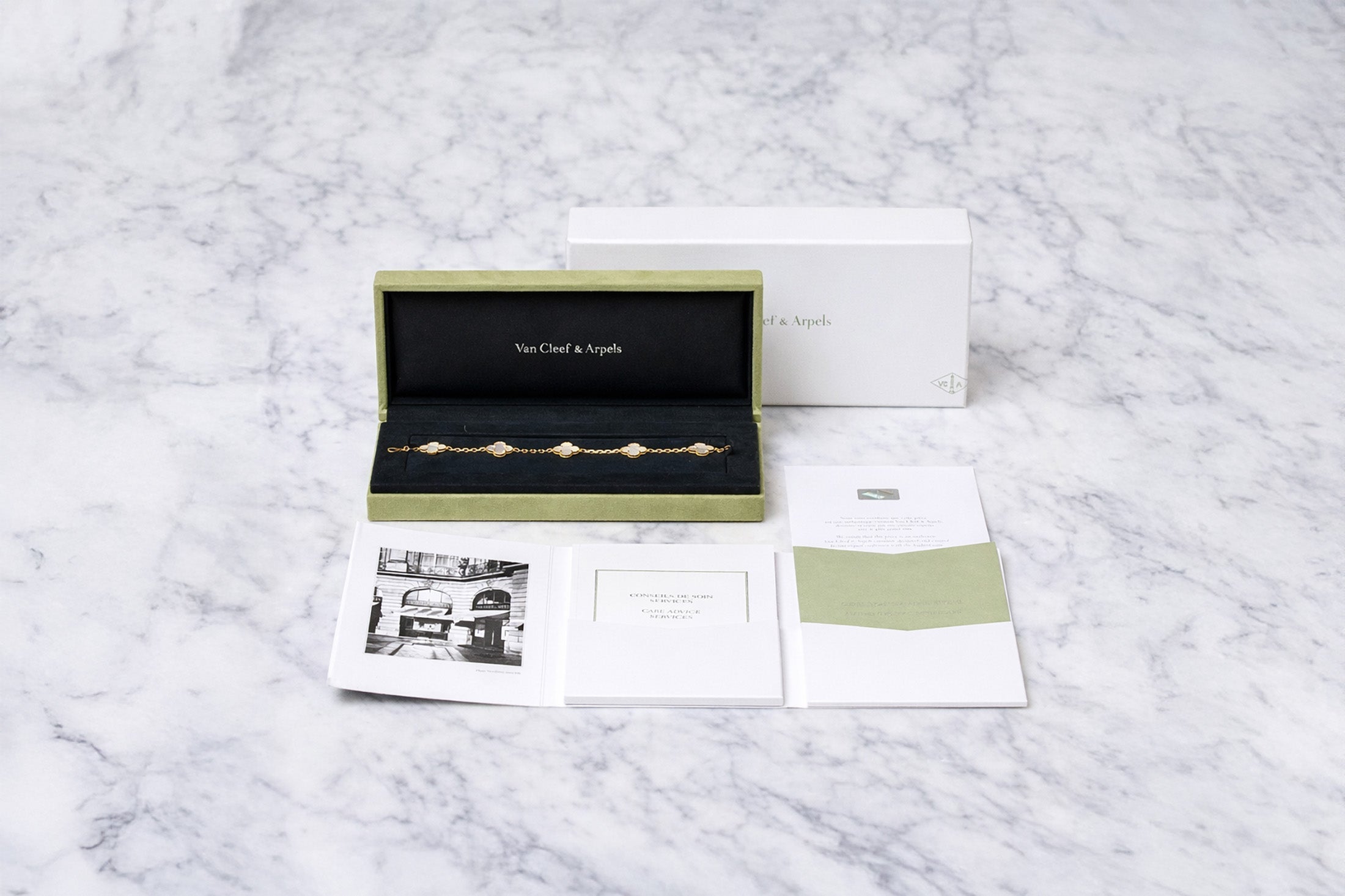
Vintage Van Cleef & Arpels boxes show their age in the materials, construction, and branding. Boxes from the 1960s and 1970s might have different logo placements, box shapes, or interior lining colors compared to today’s navy blue cases.
Older boxes have a texture and quality that reflect what was available at the time. We notice that vintage packaging often has a bit of wear, fading, or patina that feels right for its age, not the fake distressing you sometimes see. Modern reissues come in today’s Van Cleef & Arpels packaging with the current dust bags, ribbons, and branded extras.
Box construction matters, too. Vintage boxes used different hinges, clasps, and interior cushions. If someone says you’re getting a 1970s Alhambra but it comes in a box style that didn’t appear until 2010, that’s a red flag you shouldn’t ignore.
Collecting and Shopping Advice From Experts
Navigating the Van Cleef & Arpels market means knowing where to shop and when to ask for help. Whether you’re searching for a vintage Alhambra from the ‘70s or a modern haute joaillerie piece, the right sourcing strategy and some specialist input can really save you from expensive mistakes.
Where to Find Authentic Pieces
Van Cleef & Arpels boutiques are the safest bet for new pieces. They give you certificates of authenticity, the right packaging, and access to the latest collections. If you want something new or plan to commission a custom piece, start here.
For vintage and pre-owned pieces, stick with established luxury jewelry dealers who have solid authentication routines. Look for sellers who show detailed provenance, clear photos of serial numbers and hallmarks, and offer returns. Auction houses like Christie’s and Sotheby’s sell authenticated vintage Van Cleef, but competition can push up prices.
Online marketplaces need extra caution. Even the best platforms with authentication sometimes miss clever fakes. Always double-check the serial number yourself and look closely at photos for crisp engraving and other details. Good pre-owned dealers usually offer 30-90% of the original retail price for genuine pieces in nice shape.
If a deal seems too good to be true, it probably is. Authentic Alhambra necklaces don’t go for half price unless there’s a catch.
Consulting with Van Cleef & Arpels Specialists
Professional authenticators notice details most buyers miss. They check engraving under magnification, compare serial numbers to production records, and look at clasp mechanics that change over the years. This kind of expertise is a lifesaver when you’re looking at vintage pieces with no original paperwork.
Van Cleef & Arpels boutiques can authenticate pieces you bring in for repair or maintenance. They don’t give out written certificates for items bought elsewhere, but their staff can confirm authenticity during a consultation. This is especially useful for inheritance pieces or gifts with murky origins.
Independent authentication services usually charge $50-200, depending on the piece. They’ll want clear photos of serial numbers, hallmarks, clasps, and motifs. Many also offer certificates you can use for insurance or resale.
If you’re buying a high-value vintage piece, consider getting an in-person appraisal before sealing the deal. A little upfront expense can save you from a costly mistake.
Frequently Asked Questions
Understanding the differences between vintage and modern Van Cleef & Arpels pieces means looking at things like serial numbers, hallmarks, craftsmanship, and materials that changed over time. These details help collectors and enthusiasts figure out authenticity and age.
How can I tell if a Van Cleef & Arpels piece is truly vintage, you know, without needing a time machine to check?
We look for hallmarks and stamps that changed over the years. Pieces from before the 1970s usually have the VCA mark with French hallmarks, a maker’s mark, and gold standard stamps. You’ll see hand-finishing techniques on older pieces that aren’t part of modern production.
Patina tells its own story. Gold warms up in tone as it ages, and gemstone settings collect wear that fits their age. Clasps are another clue, vintage pieces might use different spring ring or box clasps than what you see today.
Serial numbers didn’t become standard until later. Most Van Cleef & Arpels jewelry from before the 1990s won’t have the serial numbers we expect now, which actually helps confirm their vintage status.
What are the telltale signs that a Van Cleef & Arpels jewel comes straight from the contemporary chic collection instead of the retro rad archives?
Modern pieces have laser-engraved serial numbers that look crisp and perfectly uniform. These codes, letters and numbers, usually sit on a small plaque or right on the metal, and Van Cleef & Arpels registers them in their system.
Finishing on new pieces is all about machine precision. You’ll see sharper edges, consistent stone settings, and even metal thickness. Modern gold has a brighter, more even color thanks to today’s alloys and polishing.
Contemporary pieces come with a lot of paperwork, certificates, detailed receipts, sometimes even a little passport booklet for the jewel. Vintage pieces rarely hang onto that much documentation.
Could you help a fashionista out by spilling the beans on tracking serial numbers for Van Cleef & Arpels pieces, pretty please?
Serial numbers became the norm for Van Cleef & Arpels in the 1990s. Before that, hallmarks and maker’s marks were the main identifiers.
Modern serial numbers mix letters and numbers, and their format has changed over the years. Current codes can be verified through Van Cleef & Arpels archives. If you want to check a serial number, your best bet is to contact a Van Cleef & Arpels boutique, they can look it up in their system.
Where you find the serial number depends on the piece. Bracelets usually have it near the clasp or on a little plaque. Necklaces might have it on the jump ring or clasp. Rings often hide it on the inside of the band.
What's the scoop on differences in craftsmanship between old-school glam Van Cleef & Arpels and their newer, sleeker cousins?
Vintage pieces show more hand-finishing. You’ll spot file marks, tiny irregularities in stone settings, and little signs of individual artisans at work. The backs of vintage pieces are often a bit rougher than the mirror polish you get on modern ones.
Stone setting has changed a lot. Older pieces used classic prong and bezel settings with visible metalwork, while newer items often feature the Mystery Set technique. That’s the invisible setting where stones are cut to fit perfectly, something you just didn’t see as much in earlier decades.
Weight varies, too. Vintage jewelry tends to be heavier, since modern manufacturing can make pieces sturdy with less metal. Vintage gold also feels softer because of the alloys used back then.
Are there specific materials or gemstones that Van Cleef & Arpels favoured in the past versus what they're all about today?
The Alhambra collection says it all. When it launched in 1968, you’d see tiger’s eye, coral, malachite, and mother-of-pearl, those stones were all the rage and fit the era’s style.
Modern collections have added new materials and techniques. There are more diamonds, especially in pavé settings, and materials like grey mother-of-pearl and carnelian have come in recently. You’ll also find ceramic and advanced synthetics that didn’t exist back in the day.
Gold alloys have shifted, too. Vintage pieces used 18k gold with different alloy mixes, giving the metal a warmer, more yellow look. Modern 18k gold is brighter and more uniform, thanks to today’s industry standards.
Got any insider tips on the hallmark styles that'll scream 'I'm vintage, darling' versus 'I'm fresh off the runway' for Van Cleef & Arpels gems?
Vintage hallmarks? You’ll spot the VCA initials in fonts that actually changed over the decades, sometimes you can almost date a piece just by the lettering. French pieces from the mid-1900s? Look for the little eagle’s head stamped for 18k gold, plus a maker’s mark tucked inside a diamond shape. These old stamps go deep into the metal and, honestly, they’re a bit less crisp than the flawless laser jobs you’ll see now. That’s part of their charm.
Modern hallmarks, on the other hand, get laser-engraved with almost surgical precision. You’ll see the full "Van Cleef & Arpels" or just the VCA logo, plus serial numbers, all looking a bit too perfect. The difference in depth and sharpness stands out once you know what to look for.
Something else, where the hallmarks hide out has changed, too. Older pieces usually stash them in discreet, tiny spots so they don’t mess with the design. Newer ones? The marks are bigger, easier to find, and honestly, they’re right where you’d expect if you’re checking for authenticity. Guess that’s what the market wants these days.
