
Common Red Flags in Fake Chanel Bags: What Consignment Buyers Must Check
Check out our Chanel collection!
Buying a pre-owned Chanel bag through consignment can feel like striking gold if the piece is authentic. The luxury resale market has exploded in recent years, and unfortunately, so has the quality of counterfeits flooding the space.
The interior "CHANEL ®" label, hardware engraving thickness, and date code formatting are your first line of defense against purchasing a fake bag.
Even experienced collectors sometimes get tripped up by replicas that mimic everything from quilting patterns to authenticity cards. Counterfeiters have become incredibly sophisticated, copying details that used to be foolproof.
Knowing what to check before handing over thousands of dollars could save you from a costly mistake and a major disappointment.
Authentic Chanel bags have consistent markers across all models and production years. Once you know the details replicas consistently mess up, spotting a fake becomes a lot easier. Whether you are eyeing a Classic Flap or a Wallet On Chain, these red flags apply universally and can help you shop consignment with a bit more confidence.
Key Takeaways
- Check the interior label's font weight and stitching thickness; fakes usually have inconsistent proportions
- Examine hardware engravings replicas often show thinner text or weird spacing on buckles and zippers
- Verify date codes match production years and inspect if CC logos and numbers follow authentic formatting
Why Chanel Bag Authentication Matters for Consignment Buyers
Buying Chanel bags through consignment channels demands careful verification. Counterfeiters are getting smarter, and the financial stakes are high. The difference between a real Chanel and a fake goes way beyond looks it is about resale value, legality, and investment security.
The Investment Value of Authentic Chanel Bags
Real Chanel bags tend to hold their value, sometimes even appreciating beyond their original retail price. The Classic Flap, for example, has seen price hikes that sometimes outpace inflation.
When you buy authentic Chanel through reputable consignment, you are acquiring an asset that will likely hold its worth. These pieces can be resold later at competitive prices, making them genuine investment pieces, not just splurges.
Key value factors:
- Limited production runs create scarcity
- Chanel's regular price increases boost historical value
- Strong secondary market demand from collectors
- Brand prestige that has stuck around for decades
A fake Chanel bag, on the other hand, has zero resale value. No legitimate consignment shop or buyer wants counterfeits, so money spent on a replica? Gone for good.
The Risks of Purchasing a Fake Chanel Bag
Buying a fake Chanel is not just about losing money. Many countries have laws against buying or selling counterfeit luxury goods, and buyers can face legal trouble depending on where they live.
There have been cases where customs officials seized counterfeit items during international travel, leaving owners empty handed and possibly facing fines. Some places even go after buyers, not just sellers.
Quality is another headache. Fake bags use cheap materials that fall apart hardware tarnishes, leather cracks, and stitching fails way sooner than it should.
There is also the social angle. Carrying a fake can hurt your credibility, especially among folks who know their luxury goods. In some circles, it can even affect your professional reputation.
Consignment Market Trends and Counterfeit Dangers
The consignment market for luxury handbags has exploded, hitting billions in annual sales. This growth has attracted sophisticated counterfeiters, especially in second hand channels where buyers might not know all the authentication tricks.
Modern superfakes can copy serial numbers, hologram stickers, and hardware engravings. These high quality counterfeits can fool casual buyers and sometimes even resellers who do not specialize in luxury authentication.
Online consignment platforms are tricky. Without being able to touch or inspect the bag, you are relying on photos and seller descriptions which can easily mislead.
Counterfeiters now fake authenticity cards, dustbags, and even receipts. Professional authentication services have become essential, because just looking is not enough anymore.
Most Common Red Flags in Fake Chanel Bags
When you are checking for fakes, certain tells pop up again and again. The shortcuts counterfeiters take become obvious once you know what real Chanel standards look like from the geometry of the diamond quilting to the feel of genuine caviar leather.
Misaligned Diamond Quilting Patterns
Authentic Chanel bags have diamond quilting that lines up perfectly across surfaces pockets, flaps, seams. Fakes often have diamonds that do not match up at transition points or patterns that shift abruptly. This happens because counterfeiters do not use the precision cutting and planning that Chanel does.
The quilting should flow smoothly around corners and edges. On a real bag, the diamonds are consistent in size and shape, even when the leather curves. Fakes often show distorted diamonds near hardware or uneven spacing.
Check how the quilting meets at the central flap. Genuine bags have diamonds that mirror each other on both sides of the center. If one side is off or the pattern does not match, that is a big red flag.
Incorrect Stitch Quality and Stitch Count
Chanel's stitching is super consistent, with tight, even stitches and a specific stitch count per inch usually 9 to 11 per diamond, depending on the bag size. Look for uniform stitches, no loose threads, and even spacing. Fakes usually have sloppy handiwork loose threads, skipped stitches, or weird spacing.
Thread quality matters, too. Real Chanel uses premium thread that matches the leather and does not fray. If you see uneven lines, puckering, or shiny, cheap looking thread, it is probably a fake.
Poor Quality Caviar Leather or Material Substitutes
Caviar leather on authentic Chanel bags has a distinctive pebbled texture soft but structured, never plasticky or stiff. Counterfeiters rarely get this right. Real caviar leather has tightly packed, uniform bumps that feel subtle, not rough.
The material should bounce back if you press it. Fakes often use embossed or stamped leather that looks okay but feels off too pronounced, too flat, or inconsistent.
Smell is a big clue. Real caviar leather has a clean, upscale leather scent. Fakes often smell like chemicals or cheap leather. If it smells like plastic, cleaning products, or just musty, walk away.
Inaccurate CC Lock and Hardware Details
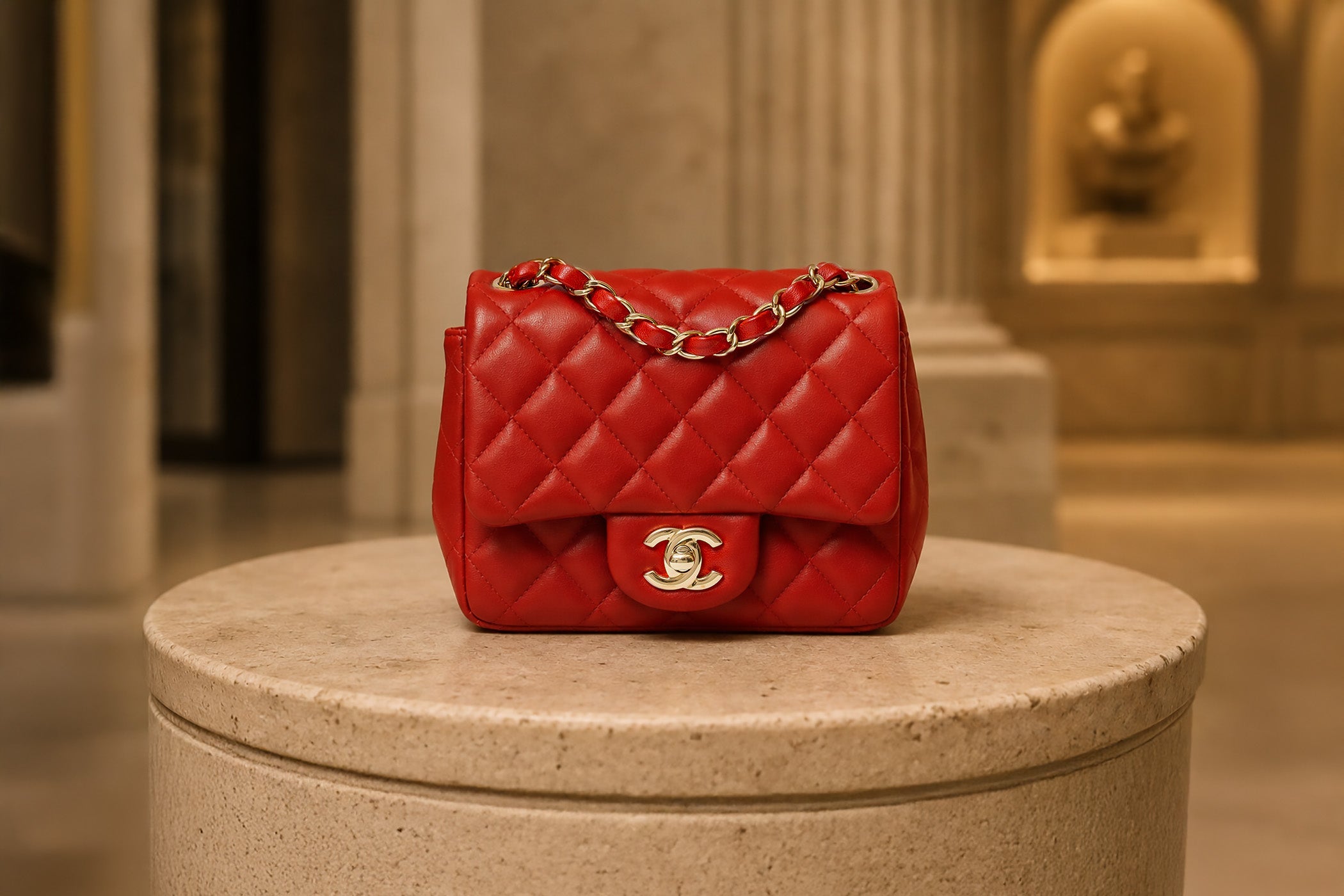
The interlocking CC logo clasp on real Chanel bags follows strict design rules. Check that the right C overlaps the left at the top, and the overlap reverses at the bottom. The C edges should be flat, not rounded or beveled.
Hardware color and finish must match across all components. Gold tone hardware? The CC lock, chain, grommets, and interior stamp should all be the same shade. Vintage and pre 2008 bags have richer 24 karat gold plating with a small hallmark on the upper left C tip.
Backplate screws tell you a lot. Chanel used only flathead screws until 2015, then switched to star shaped screws. If you see Phillips head screws or mismatched types, it is a fake. The backplate should have sharp "CHANEL" and "PARIS" etching with perfect spacing and Chanel's unique typeface.
Decoding Chanel Hardware: What to Inspect
Chanel hardware has quirks that counterfeiters struggle to mimic, from the weight of the chains to the type of screws. Details here are among the most reliable fake spotting clues.
Weight and Finish of Chains and Clasps
Real Chanel bags have hardware that feels hefty and luxurious. The chains should have weight, not feel hollow or flimsy. When you pick up an authentic Classic Flap, the leather and chain strap has a certain heft that fakes rarely match.
The finish is consistent across all metal parts. Polished gold, aged ruthenium, light gold it should all match. Fakes often show slight differences in tone between the CC lock and zipper pulls.
Authentic hardware develops a soft patina over time but will not chip or flake. Look for smooth, even plating no rough patches or streaks. The metal should feel solid, never thin or poorly made.
What to check:
- Chain links should be uniform
- Hardware weight should feel substantial
- Finish should match across all pieces
- No tarnishing, chipping, or odd color changes
Phillips Head Screws Versus Alternatives
Chanel uses flathead screws on hardware not Phillips head screws. This is one of the easiest checks. If you spot a Phillips head screw on a Chanel bag, it is fake.
Flathead screws on real bags sit flush and even. They are positioned consistently and align with the hardware. Counterfeiters use Phillips head screws because they are easier to source.
Check screws on the CC lock, chain attachments, and any plate hardware. Each screw should have clean slots, no rough edges, and be tight and secure.
Engraving Clues on Zippers and Plates
Chanel engravings are crisp and clean, with perfect spacing and alignment. The "CHANEL" engraving on zippers, the CC lock, and hardware plates should have uniform depth. Fakes often show thick, thin, or slightly crooked fonts.
Zipper pulls should have clear Chanel markings, precisely etched not stamped or pressed. Blurry or inconsistent letters are a sign of a fake.
On pre 2009 bags, you might see hallmarks like "W" or "///" on 24k gold hardware, usually at the corners of the CC lock. These marks show gold origin and add another authentication layer. Current bags may have "Chanel" engraved on the CC hardware instead.
The interior "CHANEL ®" label is another checkpoint. Authentic labels have thin, evenly spaced letters and consistent stitching. Thick letters or uneven stitches? Probably a fake.
Serial Numbers, Date Codes, and Microchips
Chanel's authentication systems have evolved a lot since the 1980s, from simple serial numbers to microchip tech. Knowing how these systems work and what real ones look like is key to spotting counterfeits.
How to Spot Fake Serial Numbers
The serial number appears on a sticker inside the bag, and counterfeiters often mess up the details. On an authentic Chanel, the sticker looks clean and professionally applied never cheap or crooked.
Check a few things: The "CC" logos should be thinner than the numbers. Fakes usually get this backwards, with thick "CC" logos and spindly, weak numbers.
Font weight matters. Authentic stickers use consistent, well spaced type that looks refined. If the numbers are bunched together or the font looks like a home printer, that is a red flag.
The sticker's quality says a lot, too. Real Chanel uses high quality adhesive stickers that sit flat no bubbling or peeling.
Date Code Changes Through the Years
Chanel's date code system follows a pattern that helps date bags. Bags from 2021 onwards use microchips; 2020 bags start with 30; 2019 bags start with 27, 28, or 29.
Here is the breakdown:
- 2021 onwards: Microchips
- 2020: 30XXXXXX
- 2019: 27XXXXXX, 28XXXXXX, 29XXXXXX
- 2018: 25XXXXXX early, 26XXXXXX late
- 2017: 23XXXXXX early, 24XXXXXX late
- 2016: 22XXXXXX late to early 2017
- 2015: 21XXXXXX late to early 2016
The pattern goes back further, with each year or two getting a new starting number. Bags from 1986 to late 1988 started with 0XXXXXX. If a seller says their bag is from 2019 but the serial starts with 25, something is off.
Microchipped NFC Tags in New Chanel Bags
Chanel ditched the old serial number stickers back in 2021 and started putting NFC microchips right into the bag's hardware. This move really upped the game against counterfeiting.
The chip holds the bag's authentication data. You can scan it with an NFC enabled phone, though Chanel boutiques use their own special readers. There is no visible number you can read by hand anymore.
So, if you are checking out a newer Chanel, do not expect to see that familiar white sticker inside. Some counterfeiters still slap fake stickers in their bags they have not quite figured out the chip thing yet. If someone claims they are selling a "brand new 2025 Chanel" but it has a serial sticker instead of a chip, that is a huge warning sign.
Interior Details: Stamps, Logos, and Craftsmanship
Inside a Chanel bag, you will spot way more clues about authenticity than you might think. Fakes usually mess up the details things like stamps, font, and what is included with the bag.
CHANEL Brand Stamp and Country of Origin
The interior "CHANEL ®" stamp is probably the best checkpoint for authentication. On real bags, the letters are all the same thickness, and the stitching matches that weight. Fakes? You will see skinny letters with thick, clumsy stitching does not take much to spot the difference.
Look for the "MADE IN FRANCE" or "MADE IN ITALY" stamp inside the first flap. Chanel uses specific fonts for these, and the placement stays consistent. Fakes often slap these stamps too high, too low, or at weird angles.
After handling hundreds of real Chanels, I have never seen the stamp quality slip. The depth of the impression is always the same, and if there is ink, it is crisp never bleeding into the leather.
Alignment and Font of Interior Markings
Font inconsistencies give away most fake Chanels right away. On authentic bags, the letters, numbers, and symbols are all in perfect proportion. Fakes tend to cram the "CHANEL" text too close to hardware or leave awkward gaps.
Check the "CHANEL PARIS" engraving on buckles. On real bags, "CHANEL" sits farther from the bottom edge, and "PARIS" is noticeably thicker. Counterfeits just cannot get this right.
Zipper engravings are another giveaway. Real Chanel zippers have thin "CHANEL" text, while fakes engrave it too heavy. The "CC" logo on authentic zippers is thick and balanced, not stretched out or flimsy like on replicas.
Tell Tale Signs in Authenticity Cards and Inclusions
Chanel's authentication cards come with security features that fakes rarely nail. The date code sticker matches the serial on the card, and both have their own quirks. Real cards show thin "CC" logos and thick numbers; fakes usually get this backwards.
Serial numbers also reveal when the bag was made. For example, a 2025 bag should use a microchip, following Chanel's system.
The card stock matters too. Real cards feel a certain weight and texture fakes try, but they are usually off. Hold the card under direct light and look for the right holographic shimmer and sharp printing.
Model Specific Checks: Classic Flap vs. Wallet On Chain
Different Chanel models have their own quirks, and counterfeiters often fumble the details. The Classic Flap and Wallet On Chain are two models where fakes consistently fall short.
Unique Features of the Chanel Classic Flap
The Classic Flap has some telltale features. The CC lock should feel heavy, with edges that are a bit rounded not sharp or overly shiny.
Fakes often mess up the quilting at the pocket it rarely lines up where the pocket meets the main body. Real ones always have perfect diamond alignment.
Check the interior metal strap attachment. On authentic bags, the hardware is thick and the "CHANEL" engraving is solid. Replicas usually have thin, weakly stamped text.
Leather quality is another big one. Genuine Classic Flaps use supple but structured leather. Caviar leather should have larger, more defined diamonds; fakes are usually flatter and smaller.
How Fakes Miss Wallet On Chain Details
Most fake WOCs Wallet On Chain trip up on the interior inscriptions. One side should have the Chanel logo with thick, bold letters; the other side, the manufacturing location in a boxy font.
Counterfeits often use thin, spaced out text, and the little CC logo looks weak instead of bold.
Stitching is a dead giveaway. Real WOCs have perfectly straight stitches fakes angle off or sit too deep in the leather.
Look at the rear pocket quilting. Authentic bags line up the diamonds perfectly; fakes do not.
The chain on fake WOCs tends to be way too shiny. Real chains have a muted, almost washed out look that does not scream for attention.
Frequently Asked Questions
Genuine Chanel bags have consistent stitching, well weighted fonts, and materials that fakes just cannot match. Knowing these details can make all the difference when you are trying to spot a real one.
How can I spot a fake Chanel bag from the quality of the stitching?
Real Chanel bags use thick, even stitches that are easy to see and spaced just right usually 9 to 11 stitches per inch. Every stitch is the same length and tension.
Fakes often use thin threads, and the stitching looks rushed or sloppy. You will see tight spots, loose spots, and uneven spacing if you look closely under good light.
Focus on the straps and bottom corners. These areas really show off the construction quality. Authentic Chanel does not cut corners, even where you might not look first.
Are there tell tale signs in the lining of a Chanel bag that indicate it is not authentic?
The "CHANEL ®" stamp inside is a solid checkpoint. Real bags have letters with even thickness, and the stitching that forms the letters matches up.
Fakes usually have skinny text and thick, messy stitching. Counterfeiters cannot seem to get the font weight right, so this is a quick thing to check.
The lining should feel sturdy but not slick. Chanel uses quality fabrics with a bit of texture. Replicas often use lining that feels too smooth or plasticky.
What are the common discrepancies in Chanel logo hardware that point to a counterfeit?
The interlocking CC logo on real bags reflects light in a way fake metal just cannot. Hold it under a light and you will see what I mean.
Fakes look flat and do not reflect much. The CCs on replicas are usually too thin or spaced awkwardly.
On buckles and clasps, check the "CHANEL PARIS" engraving. Real ones have the right spacing and the "PARIS" is thick enough fakes rarely get both right.
Can the authenticity card and serial number always be trusted in verifying a Chanel bag?
Honestly, you cannot trust authenticity cards alone. Counterfeiters have gotten good at copying them. Many fake bags come with cards that look legit but have tiny errors in print or layout.
The date code is more reliable if you know what to look for. Bags from 2020 start with 30, 2019 bags use 27, 28, or 29.
Check how the code is stamped. Real codes have thin CC logos and thick numbers; fakes usually flip this, with thick CCs and skinny, backwards numbers.
What discrepancies in the bag's overall shape and structure should I look out for to spot a fake?
Real Chanel bags hold their shape, thanks to quality materials and structure. They do not sag or collapse, even after years.
Quilting patterns on Classic Flaps should line up perfectly at every seam. Fakes often have misaligned diamonds, especially at the edges and closures.
Look at the base an authentic bag sits flat and steady. Fakes often have bases that curve or buckle because they lack proper internal support.
How does the smell of a Chanel bag help in determining its authenticity?
Genuine Chanel bags give off a leather scent that is rich but not overpowering. Most people notice it as natural, maybe even a bit sweet thanks to the high quality lambskin or caviar leather Chanel uses.
Fake bags, on the other hand, tend to smell chemical or plasticky. That is usually because they use cheap materials and glues, which can give off some pretty harsh fumes, especially right out of the box or after being stored away.
Honestly, trusting your nose can be a decent first step, but it is not the whole story. Smell adds another clue, but you will want to check a few other things before calling a bag the real deal.

