

A Comprehensive Guide to Hermès Bag Styles: Know the Names and Their Unique Features
Check out our Hermès collection and Birkin bags!
TL;DR:
Most Hermès bags can be identified by one defining detail. The Kelly is always trapezoid, the Constance closes with a working H clasp, the Bolide was the first handbag with a zip, the Evelyne carries a perforated H, the Lindy has its handles on its sides and the Roulis closes with a jewel clasp based on the Chaîne d’ancre link. This guide explains the name, history and signature detail of ten Hermès bag styles, using only what Hermès publishes on its official website.
A Birkin, a Kelly and a Constance can look alike from across a room, and names such as Picotin, Roulis or Herbag mean little until you know what to look for. If you are trying to tell Hermès bag styles apart, or working out which one suits the way you carry your things, the quickest route is to learn the one detail that defines each model.
This guide covers ten styles: Birkin, Kelly, Constance, Bolide, Evelyne, Picotin, Lindy, Roulis, Garden Party and Herbag. For each one, you will find what Hermès says about its origin, where the name comes from when the house explains it, and the feature that makes it recognizable. Every fact about Hermès comes from the house’s own website, so where Hermès says nothing about a detail, this guide does not guess.
Key Takeaways
- One detail identifies each bag. Learn the Kelly’s trapezoid shape, the Constance’s H clasp, the Bolide’s zip and the Evelyne’s perforated H, and most Hermès styles become easy to name.
- Many designs come from riding and travel. Hermès links the Bolide to car trunks, the Evelyne to horse grooming, the Picotin to oat feeder bags and the Roulis clasp to a link inspired by boats moored in Normandy.
- Choose by how you carry. Shoulder and cross-body straps, zips, padlocks, adjustable snaps and travel formats separate these bags as much as their looks do.
The house icons: Birkin, Kelly and Constance
These three are easy to confuse at a glance. Their stories also follow the Dumas family’s leadership of Hermès: Robert Dumas created the Kelly, and his son Jean-Louis Dumas is connected to both the Constance and the Birkin.
The Birkin
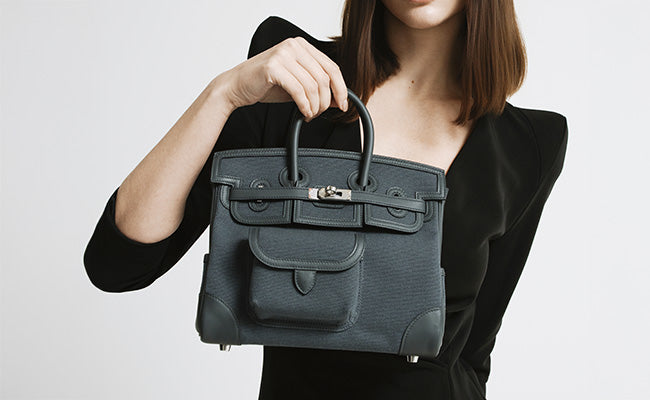
Hermès dates the Birkin to 1984. In the house’s account, the bag came out of a chance encounter between Jean-Louis Dumas and the actress and singer Jane Birkin on a flight from Paris to London, after which Dumas designed her ideal bag.
Hermès sums up the result simply: elegant and voluminous, for evening or daytime. Jean-Louis Dumas, son of Robert Dumas, led the house from 1978, a period Hermès describes as a gradual revolution of the company. That makes the Birkin the youngest of the three icons.
The Kelly
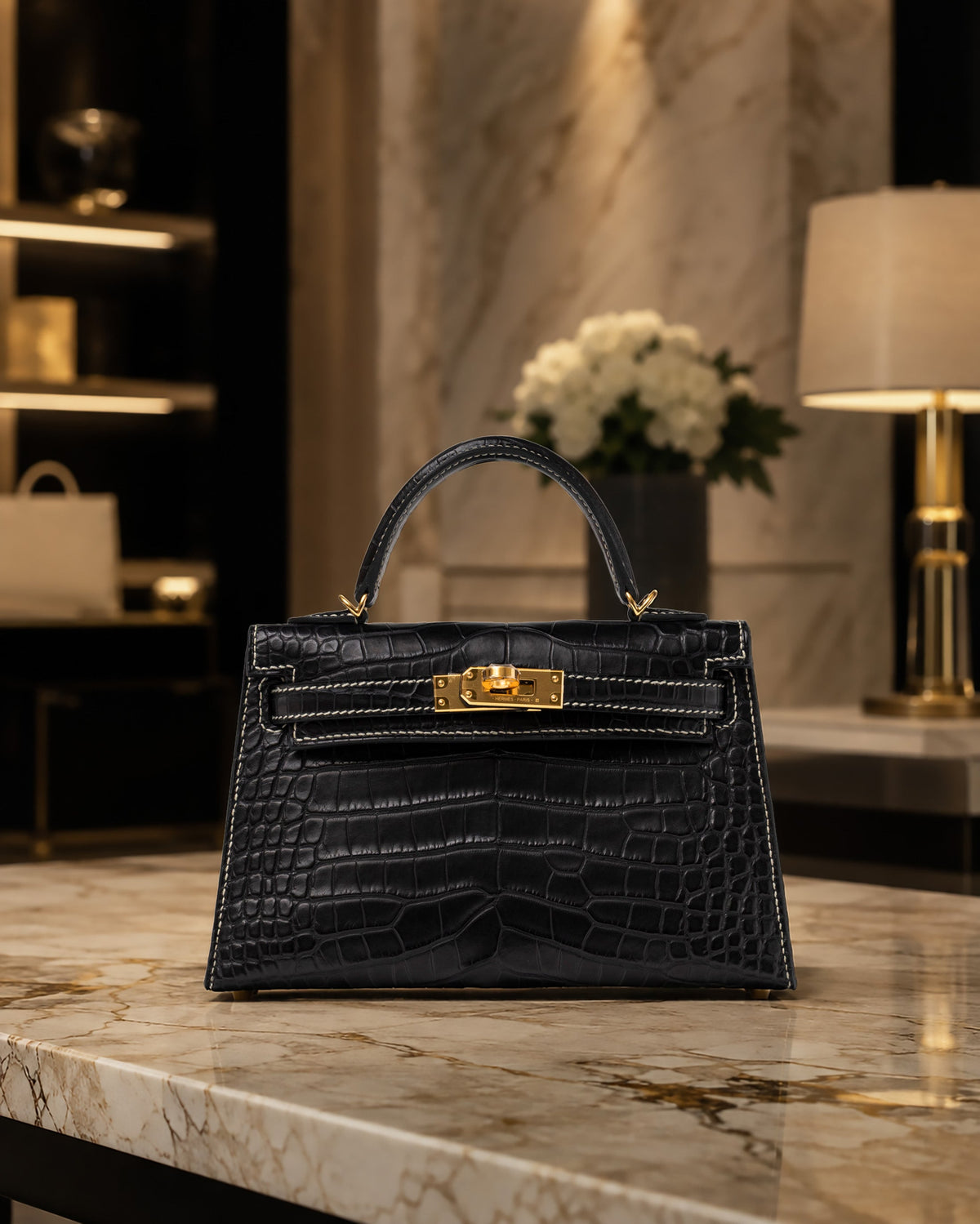
The Kelly is older than its name. Robert Dumas, son-in-law of Émile Hermès, created the ladies’ bag with straps in the 1930s, and he went on to lead the house from 1951. In 1956, a photograph of Grace Kelly carrying the bag was published around the world, and Hermès named it Kelly in honour of the princess of Monaco. Hermès also tells the story that she held the bag over her stomach to conceal the signs of her pregnancy.
What defines a Kelly, according to Hermès:
- Shape: always trapezoid, whether mini or maxi, carried by hand or worn over the shoulder.
- Hardware: signature details run from the Touret clasp to the padlock.
- Scale: available from size 40 down to a mini format, plus a maxi travel format.
- Variants: Hermès names the Kelly II Sellier (mini and 32), the Kelly II Retourne (25 and 32), and, in its men’s line, the Kelly Dépêches 25 pouch and the Kelly Messenger.
- Kellywood: two variants that bring together cabinetmaking and leather craftsmanship, one with leather and wood marquetry, the other with fine metal strips set into pin oak in a herringbone pattern.
The Constance
According to Hermès, the Constance dates from 1967. The designer responsible for the bag was pregnant at the time and named her creation after her daughter, Constance.
The defining detail is the clasp. Hermès calls it a first: the H becomes a working closure, opened and closed by a spring mechanism concealed on each side of the metal bar attached to the flap.
Hermès describes the Constance as an urban bag with a quietly sporty spirit. Its sliding strap lets it sit against the hip or on the shoulder. Models shown by Hermès include the Constance I 24 and the Constance III mini, as well as a Marble Silk edition that uses a silk marbling technique Hermès says has been carried on in Japan by several generations of the same family.
Bags born from riding and travel
Hermès began in Paris in 1837, when the harness-maker Thierry Hermès opened a workshop. That equestrian and travel vocabulary is easiest to see in the next three styles, where grooming kits, feed bags and car journeys all turn into leather goods.
The Bolide
Hermès says the Bolide was designed in 1923 to fit easily into the rounded trunks of cars.
Its story is really the story of the zip. Hermès credits an idea from Émile Hermès with the first zipper used on a handbag, combined with a leather pull tab and patented by Hermès specifically for leather goods. The house’s history page explains that, during a trip to Canada, Émile Hermès was fascinated by the American “close-all” system on the hood of a military car and obtained exclusive rights to it in 1922.
The Bolide’s curved handles are designed like harness straps. Hermès offers it in a range of sizes and carrying options, including the Bolide on Wheels and a travel-sized version. Its men’s versions, such as the Bolide à Dos backpack and the Bolide Skate 31, can be worn over the shoulder or across the body.
The Evelyne
Hermès conceived the Evelyne in 1978 as a grooming bag for horses, and it takes its name from its designer, Evelyne Bertrand.
The perforated H is practical as well as decorative. Hermès explains that the bag is sewn without a lining and that those in the know wear the perforated side against the body so the equipment inside can dry. The shoulder strap is likened to a saddle girth.
Evelyne bags are made in leather or in coloured canvas for lightness. For Fall-Winter 2025, Hermès added a new medium size, the Evelyne 23, which closes with a leather tab and snap and has a removable canvas strap for wear over the shoulder or across the body.
The Picotin
Hermès presents the Picotin as a nod to the equestrian world, with a shape inspired by the feeder bags used to hold oats.
The construction is deliberately simple. Hermès describes the bag as unlined, with clean edges and a central seam that puts the leather itself on display. An adjustable tab lets you widen or narrow the opening, and a padlock keeps watch over the closure.
Relaxed everyday styles: Lindy, Roulis, Garden Party and Herbag
These four styles are less about one famous origin story and more about how they carry. Each has a single construction detail that sets it apart from the more structured icons above.
The Lindy
Hermès describes the Lindy as a nod to the Lindy Hop, the famous American street dance of the 1920s, and as an upbeat tribute to the Year of Dance.
Its trick is handle placement. The handles sit on the narrow sides of the bag rather than on top, so the bag folds and hugs the curves of the body. The Lindy 26, for example, closes with a zip, comes with handles and a strap, can be carried by hand or worn over the shoulder, and measures 26 × 18 × 14 cm. The Lindy mini adds a shoulder strap, two interior pockets and two exterior pockets.
The Roulis
The Roulis is defined by its jewel clasp, which Hermès describes as a stylized version of the Chaîne d’ancre link, stretched to accommodate the leather flap.
That link has its own history. Hermès credits Robert Dumas with the Chaîne d’ancre bracelet, which he was inspired to create while watching boats moored in Normandy. Hermès also carries the Roulis name into small leather goods, such as the Roulis Slim wallet.
The Garden Party
Hermès frames the Garden Party as an everyday holdall with a countryside look and a city feel: leather for the city, canvas for the countryside.
Its signature is the Clou de Selle button. With a simple touch, these buttons let the bag open and adjust to whatever is inside. Plunging handles complete the look. Hermès offers the Garden Party in several sizes, including the Garden Party 30 and the Garden File 28, and also makes it as a travel bag.
The Herbag
The Herbag combines a canvas body with an unlined leather flap, and Hermès says it brings together several house signatures: straps, a bell and the Clou de Selle clasp.
Hermès names a men’s Messenger format worn across the body and a women’s size 20 for everyday essentials. The Herbag Zip 20 can be worn over the shoulder or across the body and has an exterior zipped back pocket. Hermès describes the larger Herbag Zip 31 as a travel bag, with a removable interior zipped pouch, an exterior zipped back pocket, a collapsible handle and a strap.
Leathers, hardware and where Hermès bags are made
Hermès publishes a short profile for each leather on its product pages. Three leathers that often come up when comparing bag styles:
- Togo calfskin: first appeared in the collections in 1997 and is named after an African country, after that year’s Africa theme. Hermès describes a matte, round, irregular grain created by intensive drumming, and says it softens over time.
- Epsom calfskin: first appeared in 2004 and takes its name from a town in south-east England famous for its horse races. It is a printed leather with a fine, regular grain that, according to Hermès, keeps its shape and resists scratches.
- Evercolor calfskin: first appeared in 2012 as a complement to Evergrain calfskin, in a wide palette of colours. Hermès describes a satiny, small printed grain that softens and becomes shinier over time.
Hardware finishes vary by model. Hermès product pages list finishes such as palladium-plated and yellow-gold-plated metal.
Hermès states that 100% of its leather goods are made in France. Across all its crafts, the house carries out production and training at 63 sites in the country. In 2021, the house opened the École Hermès des savoir-faire, which awards a CAP vocational qualification in leatherwork. Hermès also notes that its leather workshops moved from Faubourg Saint-Honoré to Pantin, just outside Paris, in 1992.
Hermès bag styles at a glance
Use this table as a quick reference for what Hermès says about each style.
| Bag | Origin, per Hermès | Signature detail |
|---|---|---|
| Birkin | 1984, after Jean-Louis Dumas met Jane Birkin on a Paris to London flight | Elegant and voluminous, for day or evening |
| Kelly | Created by Robert Dumas in the 1930s; named Kelly in 1956 | Always trapezoid, with Touret clasp and padlock |
| Constance | 1967, named after the designer’s daughter | H clasp with a concealed spring mechanism |
| Bolide | Designed in 1923 to fit car trunks | First zipper on a handbag; harness-style handles |
| Evelyne | 1978 grooming bag, named for Evelyne Bertrand | Unlined, with a perforated H |
| Picotin | Inspired by oat feeder bags | Unlined, central seam, adjustable tab and padlock |
| Lindy | A nod to the 1920s Lindy Hop | Handles on the narrow sides |
| Roulis | Clasp drawn from the Chaîne d’ancre link | Elongated jewel clasp over the flap |
| Garden Party | A holdall for city and countryside | Clou de Selle buttons and plunging handles |
| Herbag | Canvas body with a leather flap | Unlined flap, bell and Clou de Selle clasp |
How to choose the right Hermès bag style
Start with how you carry, then let the details decide. Each pairing below rests on features Hermès describes for that model.
- Hands-free days: the Evelyne 23 and the Herbag Zip 20 can be worn across the body, the men’s Bolide styles can be worn cross-body, and the Constance’s sliding strap sits at the hip or on the shoulder.
- A secure closure: the Bolide and the Lindy 26 zip shut, and the Picotin closes under a padlock.
- Quick access: the Garden Party’s Clou de Selle buttons open and adjust to what you carry, and the Picotin’s adjustable tab changes the size of its opening.
- Travel: look at the travel-sized Bolide, the maxi Kelly travel format, the Garden Party travel bag and the Herbag Zip 31.
- Leather feel: choose Epsom if you want a bag that keeps its shape, or Togo or Evercolor if you prefer leather that softens over time.
Size is personal, so try a bag in person before you decide. Hermès notes on its product pages that, because pieces are handmade, the dimensions shown may vary.
Final Thoughts
Once you know the detail that defines each style, Hermès bags stop looking interchangeable: the clasp, the handles or the perforations usually tell you which one you are holding. If a pre-owned Hermès bag is on your list, bring your questions about condition and authentication to Rome Station before you buy.
Fact Check and Data Sources
This article was researched and fact-checked using Hermès' official website, including its historical timeline and dedicated pages on iconic bags, leather characteristics, and craftsmanship.
Information about Rome Station's services and authentication practices was checked against Rome Station's official website.
Frequently Asked Questions
When was the Hermès Birkin created?
Why is the Kelly called the Kelly?
Which Hermès bag was the first with a zip?
Why does the Evelyne have a perforated H?
Are Hermès bags made in France?
Can I see and try on Hermès bags in person at Rome Station?
How does Rome Station authenticate Hermès bags?
Love Hermès? See More from Rome Station
Add us to your Preferred Sources on Google to see our newest Hermès guides and insider tips first.